Slippage in Signal Copying: What It Is and How to Reduce It (2026)
Slippage is the gap between the price a signal names and the price your order actually fills at. Here is what causes it in a Telegram-to-MT5 copy chain, when it is worst, and the practical ways to keep it small.
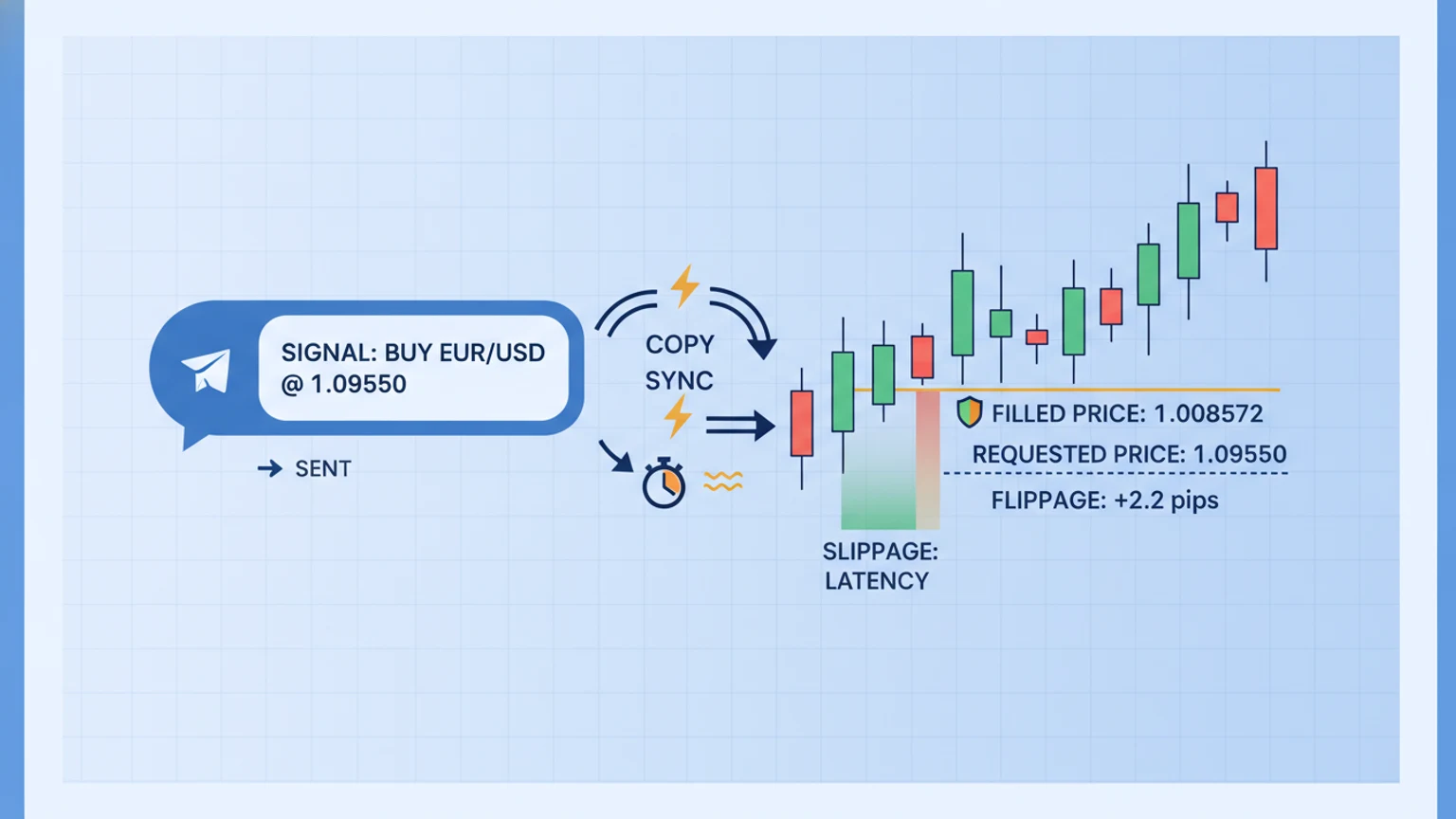
Slippage is the gap between the price a signal names and the price your order actually fills at. It happens because the market keeps moving in the split second between your order being sent and your broker filling it - so the "entry" in a Telegram post is a reference, never a guaranteed price. A little slippage is a normal cost of trading; a lot of it, usually around news or in thin markets, can quietly erode an otherwise good strategy. This guide explains exactly where slippage comes from in a Telegram-to-MT5 copy chain, when it gets worst, and the concrete steps that keep it small.
It matters more for copiers than for discretionary traders because you are always reacting to someone else's call, so a delay is built in. The good news: most of that delay is controllable, and the volatility-driven part is avoidable if you know when to stand aside.
What slippage actually is
Slippage is the difference between your expected execution price and your actual execution price. If a signal says buy EUR/USD at 1.0850 and your order fills at 1.0852, you have two pips of negative slippage. Fill at 1.0849 and you have one pip of positive slippage - a better price than expected. Both directions exist, but in fast or thin markets the negative side dominates, because price is moving away from where everyone wants in.
The key mental model: the price in a signal is the provider's reference point, not a price reserved for you. Markets are continuous auctions. By the time your order reaches the broker, the best available price may simply be different - and the broker fills you at what is actually there, not at what you hoped for.
"FX EAs came into use more than 10 years ago, and today account for an estimated 10-20% of global FX spot trading, or approximately USD 200-400 billion in turnover daily."
The anatomy of slippage in a copy chain
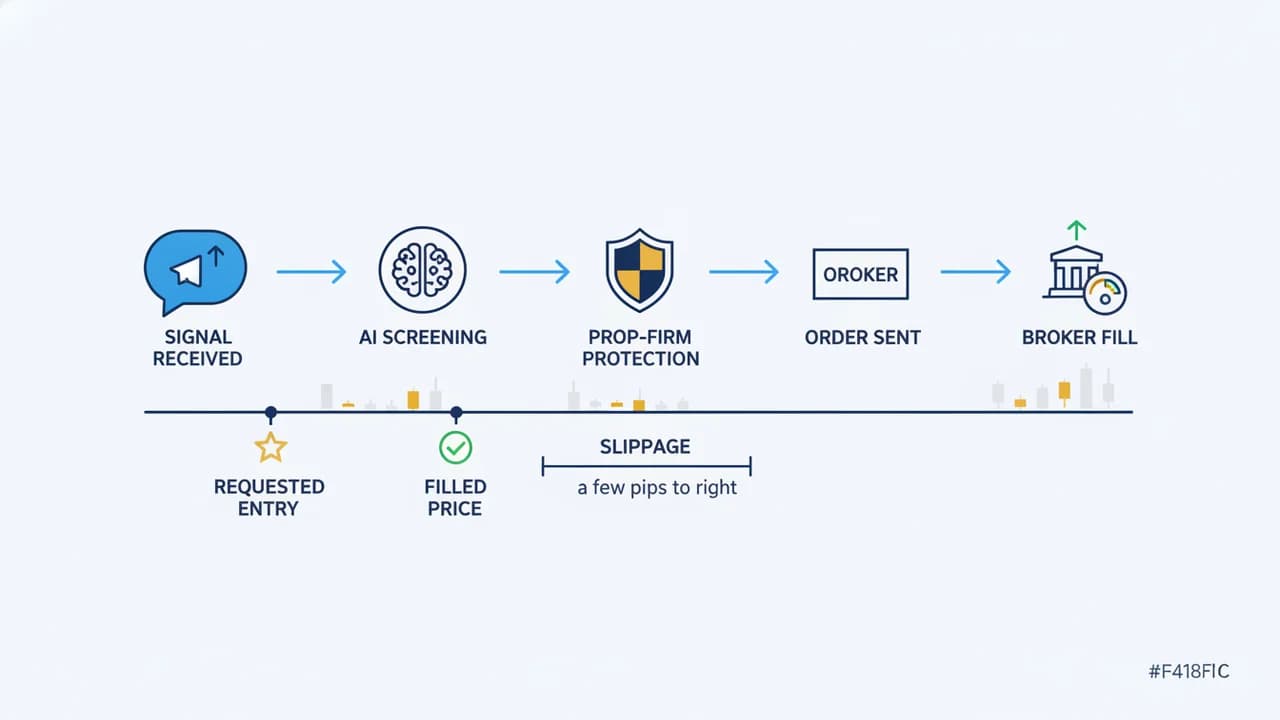
When you copy a signal, slippage accumulates across a short chain of steps, each adding a little delay while the market keeps moving:
- Signal posted. The provider sends the call at their reference price.
- Signal received and parsed. Your copier detects the message and extracts the entry, stop, and targets.
- Order sent. The copier sizes the trade and transmits an order to your broker.
- Broker fills. The broker executes against whatever price is live at that instant.
With automated cloud execution this whole chain typically takes a second or two. Copy the same signal manually - reading the message, opening MT5, typing in the trade - and you are realistically looking at 30 to 90 seconds, during which a moving pair can travel several pips. That delay gap is the single biggest reason automated copying beats manual execution: not because humans pick worse trades, but because they fill later, at worse prices. Latency is also why execution location matters, the subject of best VPS for MT5 trading and cloud copying without a VPS.
When slippage is worst
Slippage is not constant - it tracks liquidity and volatility. In deep, calm markets it is tiny and often two-sided; in thin or fast markets it spikes. The global FX market turns over trillions of dollars a day - the BIS Triennial Central Bank Survey put it at $7.5 trillion in April 2022 and the figure has grown since - which is why major pairs normally fill within a fraction of a pip. But that liquidity is not evenly spread across the clock or the news calendar.
| Market condition | Liquidity | Spread | Slippage risk |
|---|---|---|---|
| London/NY session overlap | High | Tight | Low |
| Late Asian / off-hours | Lower | Wider | Moderate |
| High-impact news (NFP, CPI, FOMC) | Spikes and gaps | Widens sharply | High |
| Weekend gap at Monday open | Gappy | Wide | High |
The extreme illustration is the Swiss National Bank shock of 15 January 2015, when the franc cap was removed and EUR/CHF collapsed roughly 30% in minutes. Liquidity evaporated, and many orders - including protective stops - filled hundreds of pips away from their requested prices, with some retail brokers pushed into insolvency. That is slippage at its most violent, and it is the kind of event a news filter is designed to keep you out of - a feature many copiers, Telegram AI Trader included, do not have, which is why the manual routine below still matters.
Why slippage hits signal copiers specifically
Three slippage effects matter most when you are copying someone else's calls:
- Entry drift. Because you act on the provider's signal rather than your own read, you are always slightly behind. On a fast breakout, the price you fill at can be meaningfully worse than the posted entry - which also changes your real risk-to-reward.
- Stop-loss slippage. A stop-loss is a market order once triggered, so it is fully exposed to slippage. In a fast move your stop can fill beyond its level, making the loss larger than planned. This is why stop placement and position sizing should assume a few pips of adverse fill, not a perfect one.
- The provider's fill is not yours. A channel may report the trade as if filled exactly at the posted price. Your account fills at a real, slightly different price, which is one reason advertised channel results rarely match subscriber results - and a reason to verify a provider's real record rather than its screenshots.
None of these mean copying is broken; they mean the posted entry is a target, not a promise, and your system should be built around that fact.
How to reduce slippage
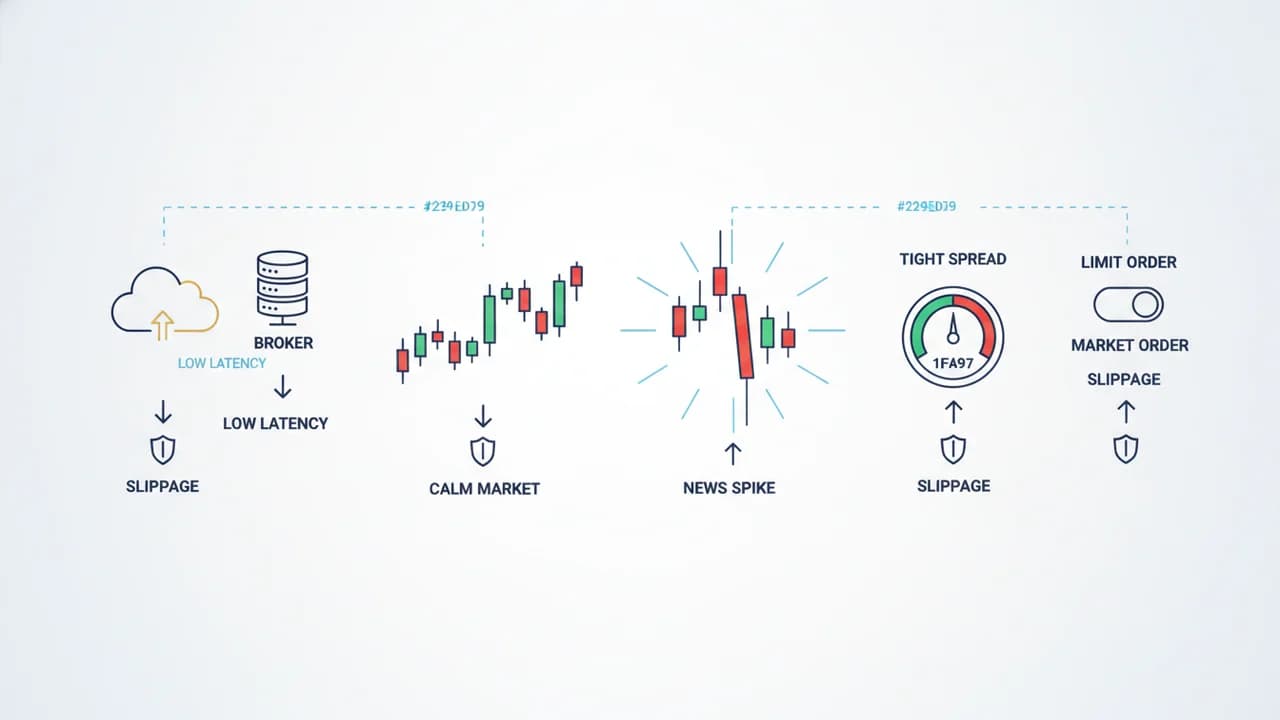
You cannot eliminate slippage, but you can shrink the controllable part and dodge the worst of the uncontrollable part:
- Cut latency. Execute close to your broker's servers. Low-latency hosting - a VPS near the broker, or a cloud copier that already runs there - removes most of the delay between signal and fill.
- Set a maximum-deviation limit. MT5 lets you cap the slippage you will accept. If the market has run past your tolerance, the order is rejected rather than filled at a terrible price - a simple, powerful guardrail.
- Avoid high-impact news entries. Most damaging slippage clusters around scheduled releases. If your copier has no news filter, pausing the channel for a few minutes around NFP, CPI and central-bank decisions does the same job manually.
- Choose a deep-liquidity broker. Tighter spreads and better fills come from brokers with genuine liquidity. A signal copier is only as good as the broker it executes through.
- Use realistic stop distances. A 5-pip stop is destroyed by 2 pips of slippage; a 30-pip stop barely notices it. Wider, sensibly placed stops are far more robust to execution noise.
The first point does most of the work for the everyday case, and the third does most of the work for the catastrophic case. Together they cover the two regimes where slippage actually hurts.
How a copier minimizes slippage automatically
How Signal Copying Works
Automatic flow from Telegram to your MT5 account
A well-built copier handles the controllable part of slippage for you. Telegram AI Trader runs execution in the cloud rather than on your laptop - no VPS to rent or maintain - so the signal-to-fill delay is measured in seconds, not the half-minute-plus of spotting a message and typing an order by hand. Every order it sends carries a fixed maximum deviation, so a fill far from the requested price is rejected rather than accepted; that limit is applied automatically on every trade and is not something you configure. It sizes each trade from your own equity, so a few pips of drift does not change your risk, and it manages exits on the server.
Two honest limits. There is no news filter: if a channel posts thirty seconds before CPI, the order goes out. And a rejected order is still a missed trade - a deviation cap protects you from a terrible fill by accepting that you sometimes get no fill at all. You can see the end-to-end flow in how to copy Telegram signals to MT5 and pair it with automatic stop-loss and take-profit so every trade leaves the gate fully managed.
The goal is not zero slippage - that does not exist - but slippage small enough and consistent enough that it is just a minor, predictable cost rather than the thing quietly draining the account.
The bottom line
Slippage is the unavoidable gap between a signal's named price and your real fill, born of the simple fact that markets move while orders travel. Most of it is controllable: cut latency with execution near your broker, cap it with a maximum-deviation limit, and dodge the dangerous spikes by not trading into high-impact news. Build your stops and position sizing to assume a few pips of adverse fill, and slippage stops being a threat and becomes a rounding error. The traders who struggle with it are the ones who treat the posted entry as a promise; the ones who thrive treat it as a target and engineer the execution around it.
See Telegram AI Trader pricing or start a free trial to copy Telegram signals to MT5 with low-latency execution and a built-in max-slippage guard on every trade.
Frequently Asked Questions
What is slippage in trading?
Slippage is the difference between the price you expected for a trade and the price it actually executed at. It happens because the market moves in the fraction of a second between your order being sent and the broker filling it. Slippage can be negative (a worse fill than expected) or positive (a better one), but in fast or thin markets it is usually negative. It is measured in pips and is a normal cost of execution, not a sign something is broken.
Why does slippage happen when copying Telegram signals?
Copying adds a delay chain. A signal is posted, your copier reads it, sends an order to your broker, and the broker fills it against live prices. Each step takes time - typically a second or two with automation, far longer if you copy manually - and the market keeps moving the whole while. The price named in the signal is the provider's reference, not a guaranteed fill, so your entry naturally lands a few pips away.
How much slippage is normal in forex?
In liquid pairs during active sessions, slippage is usually a fraction of a pip to a couple of pips and is often two-sided. It grows sharply in thin liquidity and around high-impact news, where spreads widen and prices gap - fills several pips or more away become common. The extreme case was the 2015 Swiss franc shock, when EUR/CHF moved roughly 30% in minutes and many orders filled hundreds of pips from request.
How do I reduce slippage when copying signals?
Run execution close to your broker's servers to cut latency, set a maximum-deviation (max slippage) limit so wildly off-price fills are rejected, avoid entering right before high-impact news, choose a broker with deep liquidity and tight spreads, and use realistic stop distances so a few pips of slippage does not change the trade. Automated cloud copying handles the latency part for you.
Does a VPS reduce slippage?
A VPS reduces the latency portion of slippage by running your execution on a fast server near the broker instead of a home connection, which shaves the delay between signal and fill. It does not remove slippage caused by volatility or thin liquidity. Cloud-based copiers achieve the same low-latency benefit without you renting or maintaining a VPS yourself.
Ready to Automate Your Trading?
Join traders who never miss a signal. Start with a free trial and see the difference AI-powered automation makes.
Continue Reading
Best Duplikium Alternatives for Signal Copying (2026)
The best Duplikium alternatives for 2026 - account-to-account copiers and Telegram signal copiers compared on copy type, platforms, AI/risk features, and price.
Read moreSignal AnalysisHow to Spot Fake or Scam Telegram Signal Channels (2026)
Spot fake and scam Telegram signal channels before they cost you - the warning signs, a verification checklist, and how forensics scoring proves a channel's real performance.
Read moreProp Firm TradingBest Prop Firms for Automated & Signal Trading (2026)
The best prop firms for automated and signal trading in 2026, compared on EA and copy-trading policies, drawdown rules, profit splits, and evaluation cost.
Read more