How to Spot Fake or Scam Telegram Signal Channels (2026)
A practical guide to spotting fake and scam Telegram signal channels - the red flags, why cherry-picked results look so convincing, a due-diligence checklist, and how to verify a channel's real track record before you risk a cent.
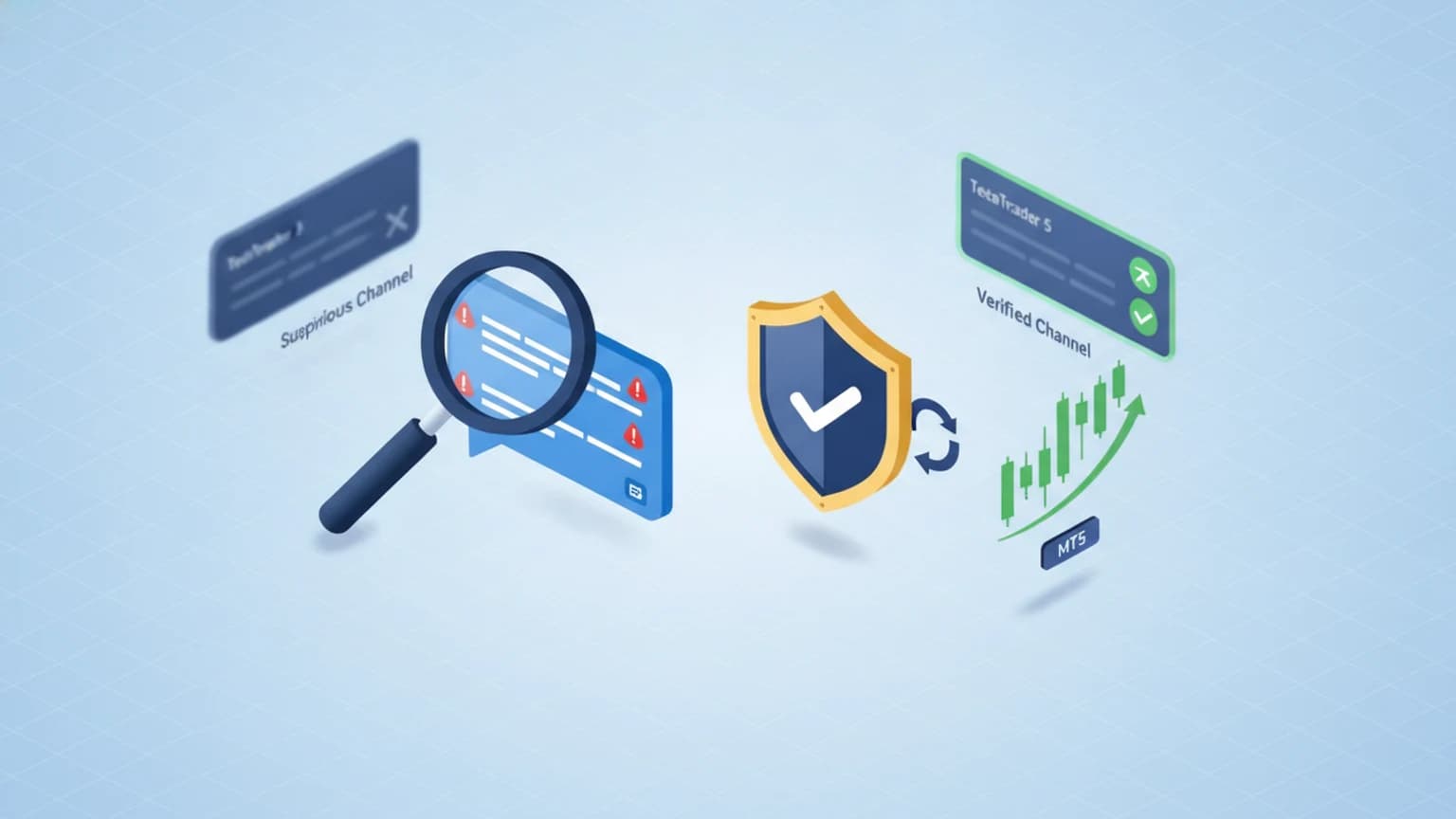
Spotting a fake Telegram signal channel comes down to one rule: never trust advertised results - verify them. The scam channels share a handful of tells - deleted or edited signals, screenshots instead of a live broker statement, no stop-loss on their calls, guaranteed-profit claims, and pressure to deposit with a specific "partner" broker. A genuine channel posts every trade in real time, leaves its losers visible, and lets its full history be checked against actual market data. This guide breaks down the red flags, explains why cherry-picked results look so convincing, and shows how to confirm a channel's real track record before you risk a cent.
The stakes are real. Between 74% and 89% of retail traders lose money trading CFDs and forex (the risk-warning range EU brokers publish under ESMA's product-intervention measures), and U.S. consumers reported $5.7 billion in losses to investment scams in 2024 - the single largest fraud category (U.S. Federal Trade Commission). A bad signal channel sits at the intersection of those two numbers: it pairs a hard game with an actively misleading guide.
What a "fake" signal channel actually is
A fake signal channel is one whose advertised performance cannot be reproduced from its real, timestamped history. That covers two groups. The first is the outright scam: a channel built to extract subscription fees or broker referral commissions, with results fabricated or manipulated from the start. The second is more common and more subtle - an honestly intended channel whose marketing is heavily cherry-picked, showing the wins and quietly forgetting the losses.
Both fail the same test, so you can treat them the same way. The question is never "does this channel seem legit?" - scammers are good at seeming legit. The question is "can I independently verify what they claim?" If the answer is no, the channel is unverifiable, and unverifiable is the only category that matters before you risk money.
"If it sounds too good to be true, it probably is. Be especially wary of promises of high returns with little or no risk." - U.K. Financial Conduct Authority, ScamSmart guidance
The biggest red flags
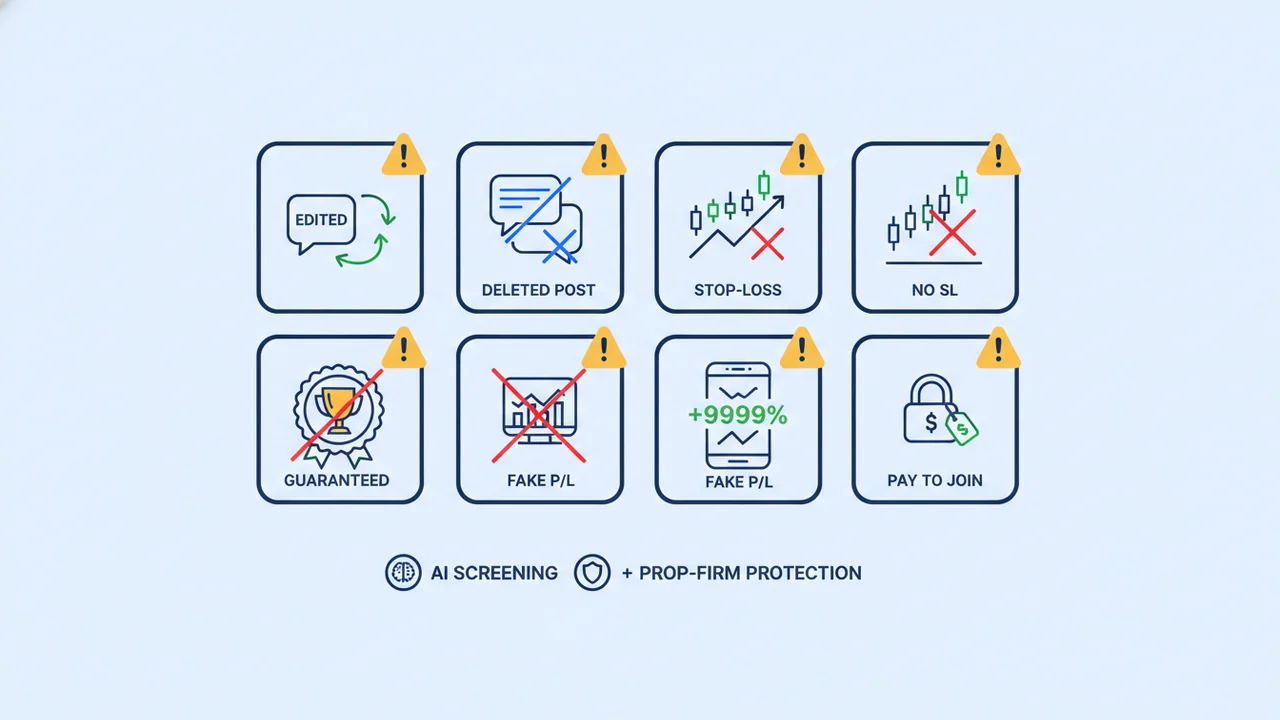
Most scam channels trip at least one of these wires. Any single flag is a reason to slow down; two or more is a reason to walk away.
- Edited or deleted signals. Telegram lets anyone edit or delete a message after it is sent. A channel that removes losing calls or quietly changes an entry after the fact is manufacturing its win rate in plain sight.
- Screenshots instead of statements. A profit screenshot proves nothing - it takes seconds to fake in a demo account or an image editor. Real proof is a read-only broker statement or a verified third-party track record.
- No stop-loss on the calls. A signal with no stop-loss can be claimed as a "win" no matter how far it goes against you, because the position is simply held until it eventually turns. That is not a strategy; it is a way to hide losses.
- Guaranteed profit or "no-loss" language. No legitimate trader guarantees outcomes. Markets are probabilistic; anyone promising certainty is selling, not trading.
- Pressure toward a specific broker. If joining requires depositing with one particular, often unregulated broker, the channel is likely earning a referral commission - sometimes a cut of your losses. That is a direct conflict of interest.
- A win rate that never drops. Real strategies have losing streaks. A channel advertising 90%+ accuracy month after month is describing a marketing number, not a trading record.
Here is the same idea as a side-by-side, because the contrast is usually obvious once you look for it:
| Red flag (scam channel) | What a legitimate channel does |
|---|---|
| Deletes or edits losing calls | Leaves every trade visible, wins and losses |
| "Proof" is screenshots | Proof is a read-only or verified statement |
| Posts signals with no stop-loss | Every signal has entry, stop, and targets |
| Guarantees profit / "no loss" | States that losses are normal and expected |
| Forces a specific deposit broker | Lets you use any regulated broker you choose |
| 90%+ win rate, every month | Reports realistic, fluctuating results |
How common is editing and deleting? We counted
Most articles on this topic assert that fake channels edit their history. We can put a number on it, because our system stores every message a monitored channel posts, including the fact that it was later edited or deleted.
Across 92 channels with at least 20 stored messages - 41,303 messages in total, measured on 15 September 2026:
| Measure | Result |
|---|---|
| Median share of messages edited, per channel | 58.2% |
| Channels editing 20% or more of their messages | 68 of 92 |
| Median share of messages deleted, per channel | 0.0% |
| Channels deleting 5% or more of their messages | 13 of 92 |
| Channels deleting 10% or more of their messages | 8 of 92 |
Two things follow. First, editing is normal - a majority of channels edit most of their messages, and much of that is legitimate: a provider updating "TP1 hit" inside the original post is an edit. Our honesty score counts edits regardless of intent, which is why a high edit rate is a question, not a verdict.
Second, deletion is not normal. The median channel deletes nothing. A channel that removes one message in ten is doing something the other 84 do not do, and a deleted trading signal has exactly one reason to disappear. That is why our scoring weighs a deletion twice as heavily as an edit: honesty = 100 - 50 x edit rate - 100 x delete rate, floored at zero.
The worst-scoring channel currently on our leaderboard posted 1,243 messages, edited 51.4% of them and deleted 52.7% - an honesty score of 21.6 out of 100. Its backtested expectancy was negative. The most honest, by contrast, edited 1 message out of 209 and deleted none.
Full method and the per-channel table: how we score Telegram signal channels.
Why cherry-picked results look so convincing
Fake performance is persuasive because of two well-documented biases. The first is survivorship: you see the channels and screenshots that worked and never the thousands that quietly closed, so the survivors look like the norm. The second is selective disclosure - a channel can post ten vague setups, highlight the two that worked, and bury the rest, and the curated feed will look like a 100% strategy even though the real record is barely break-even.
Edited messages amplify both. Because the timestamp on a Telegram post is the time it was last edited, a channel can post a hedged "looking at EUR/USD around here" message, wait for the market to move, then edit it into a precise, perfectly-timed call. The screenshot of that edited message is indistinguishable from a genuine prediction. This is why the only trustworthy record is one captured at the moment a signal is sent and checked against the price data that followed - the core idea behind AI signal provider verification.
There is also a structural reason to stay skeptical: the channel's incentives rarely match yours. As we cover in can you actually make money copying Telegram signals, most channels are paid by subscriptions or broker commissions regardless of whether subscribers profit. When the seller gets paid whether you win or lose, advertised results are marketing - and marketing is exactly what you must not trust.
How to verify a channel before you trust it
Verification is a process, not a vibe. Before following any channel - and certainly before copying its signals to MT5 - work through this checklist:
- Demand verifiable proof. Ask for a read-only broker statement or a verified third-party account (for example, a Myfxbook link), not screenshots. A channel confident in its record will have this ready; one that deflects is telling you something.
- Spot-check the history. Pick five or six older signals and compare the posted entry, stop, and targets against historical price data for that exact time. Confirm the call was posted before the move, not edited in afterward.
- Look for the losers. Scroll back far enough to find losing trades. A feed with no visible losses is not a perfect channel; it is an edited one.
- Check the broker relationship. If the channel pushes one specific broker, verify that broker is regulated by a credible authority (FCA, ASIC, CySEC) and treat any referral pressure as a conflict of interest.
- Paper-trade first. Follow the channel on a demo account for a few weeks. The gap between advertised and observed performance is the most honest number you will get.
- Search the name. A quick search for the channel name plus "scam" or "review" surfaces other traders' experiences and any regulator warnings.
This due-diligence work is exactly what catches the edited-results scam, because it forces a comparison between what was claimed and what actually happened. The U.K. Financial Conduct Authority has made the same point at scale: in 2024 it brought charges against a group of social-media "finfluencers" for promoting an unauthorised CFD trading scheme to millions of followers - a reminder that a large audience is not evidence of a legitimate track record.
The automated way: channel forensics
Real-Time Signal Analysis
Watch how we verify every signal against actual market data
Doing this by hand for one channel is feasible; doing it for dozens is not. That is where automated channel forensics comes in. Instead of trusting a channel's screenshots, a forensics system pulls the channel's real, timestamped signal history and backtests every call against one-minute market data - the actual highs, lows, and closes that followed each signal. From that it computes a trust score: a measurement of real performance that no amount of editing or cherry-picking can fake.
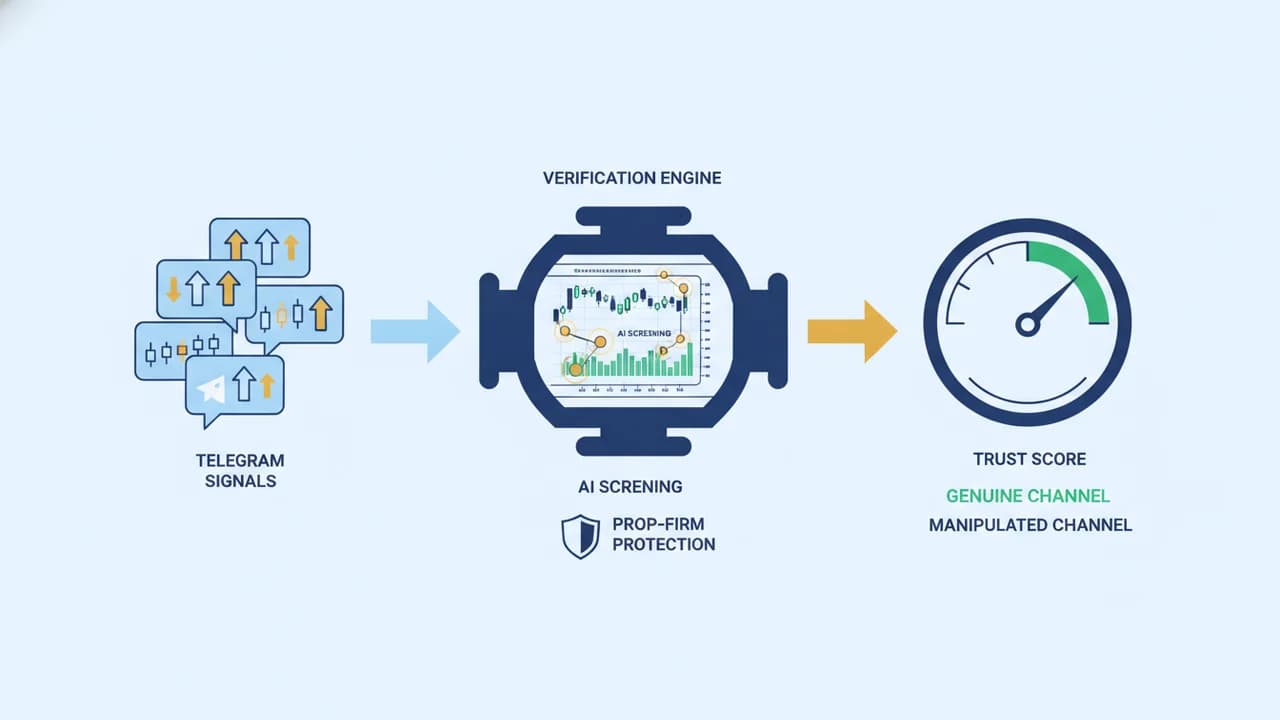
Telegram AI Trader runs this analysis automatically before you commit to a channel, so the question "is this provider real?" is answered with data rather than a gut feel. You can read how the scoring works in our channel forensics write-up and the deeper AI channel analysis system explainer. The principle is simple: a channel's advertised record is a claim, and a claim is only worth what an independent check of the market data says it is worth.
Protect your capital, not just your judgement
Even perfect verification cannot make a channel reliable forever - a once-good provider can decay, change hands, or start over-trading. So the second layer of defence is structural: never let any single channel be able to do serious damage. Cap your risk at a small percentage of equity per trade, size every position from your own balance rather than the provider's lot size, and set a daily-loss limit that stops new trades after a bad run. Done right, even a channel that turns out to be worthless costs you a controlled, survivable amount - not your account.
A copier enforces those limits automatically, which is why pairing forensics (vet the channel) with risk controls (contain the channel) is the practical answer to signal-channel risk. For a fuller routine, see our signal copier safety checklist and the curated best forex signal Telegram channels for examples of providers worth verifying in the first place.
The bottom line
Fake signal channels survive on one thing: your willingness to trust an advertised number. Remove that, and the scams have nowhere to hide. Treat every channel as unverifiable until you have checked a read-only statement, spot-checked its real history against market data, and confirmed it leaves its losers visible. Then contain the risk so no single provider can hurt you. Verification plus risk control is not glamorous, but it is the difference between a hobby that compounds and a fee paid to someone selling certainty they do not have.
See Telegram AI Trader pricing or start a free trial to copy only forensics-vetted Telegram channels to MT5 - with strict risk limits on every trade.
Frequently Asked Questions
How can you tell if a Telegram signal channel is fake?
Look for results that cannot be independently verified. The clearest red flags are deleted or edited signals, screenshots instead of a live broker statement, no stop-loss on calls, guaranteed-profit or no-loss claims, pressure to deposit with a specific 'partner' broker, and a win rate that never seems to drop. A genuine channel posts every trade in real time, keeps losers visible, and lets its full history be checked against actual market data.
Are most Telegram forex signal channels scams?
Not all, but a large share are either outright scams or honestly run channels whose advertised performance is heavily cherry-picked. The business model rewards big claims: a channel earns from subscriptions or broker referral commissions whether or not your account grows. That misalignment is why you should never trust advertised results and should instead verify a channel's real, timestamped history before risking money.
What is the most common Telegram signal scam?
The most common is the edited-results scam: the channel posts a vague or hedged signal, then after the market moves it deletes or edits the message so only winners remain visible. Closely related are pay-to-join 'VIP' channels tied to a specific broker that pays the channel a commission on your losses, and fake screenshot 'proof' that anyone can fabricate in seconds.
How do I verify a Telegram signal channel's track record?
Ask for a read-only broker statement or a verified third-party track record (such as a Myfxbook account), not screenshots. Cross-check a sample of posted signals against historical price data to confirm the entry, stop, and targets were real and posted before the move - not after. Automated channel forensics does this at scale, backtesting every claimed signal against one-minute market data to produce a trust score.
Can a signal copier protect me from bad channels?
A copier protects your capital, not your judgement. Strict per-trade risk limits, equity-based position sizing, and a daily-loss cap mean even a bad channel cannot blow your account in one session. Pairing that with channel forensics - which scores a provider's real history before you follow it - is the closest thing to a safety net when copying Telegram signals.
Ready to Automate Your Trading?
Join traders who never miss a signal. Start with a free trial and see the difference AI-powered automation makes.
Continue Reading
We Backtested 13 Telegram Signal Channels on Real Price Data. Four Made Money. (2026)
235 real Telegram signals, 134 completed trades, replayed on 1-minute price data. How many channels made money, and what the losers had in common.
Read moreProp Firm TradingFTMO Rules: The Complete Guide for Signal Traders (2026)
A complete, current guide to FTMO's rules - profit targets, daily-loss and max-drawdown limits, and trading days - written for traders automating Telegram signals.
Read moreSetup GuideTelegram Signal Copier Without a VPS: How Cloud Copying Works (2026)
How to copy Telegram signals to MT5 without a VPS using a cloud-based copier - how cloud copying works, costs, latency, and when a VPS still makes sense.
Read more