Can You Actually Make Money Copying Telegram Signals? (2026)
An honest, numbers-first look at whether you can make money copying Telegram signals - what really decides profitability, why most copy traders lose, and the few things that tilt the odds in your favour.
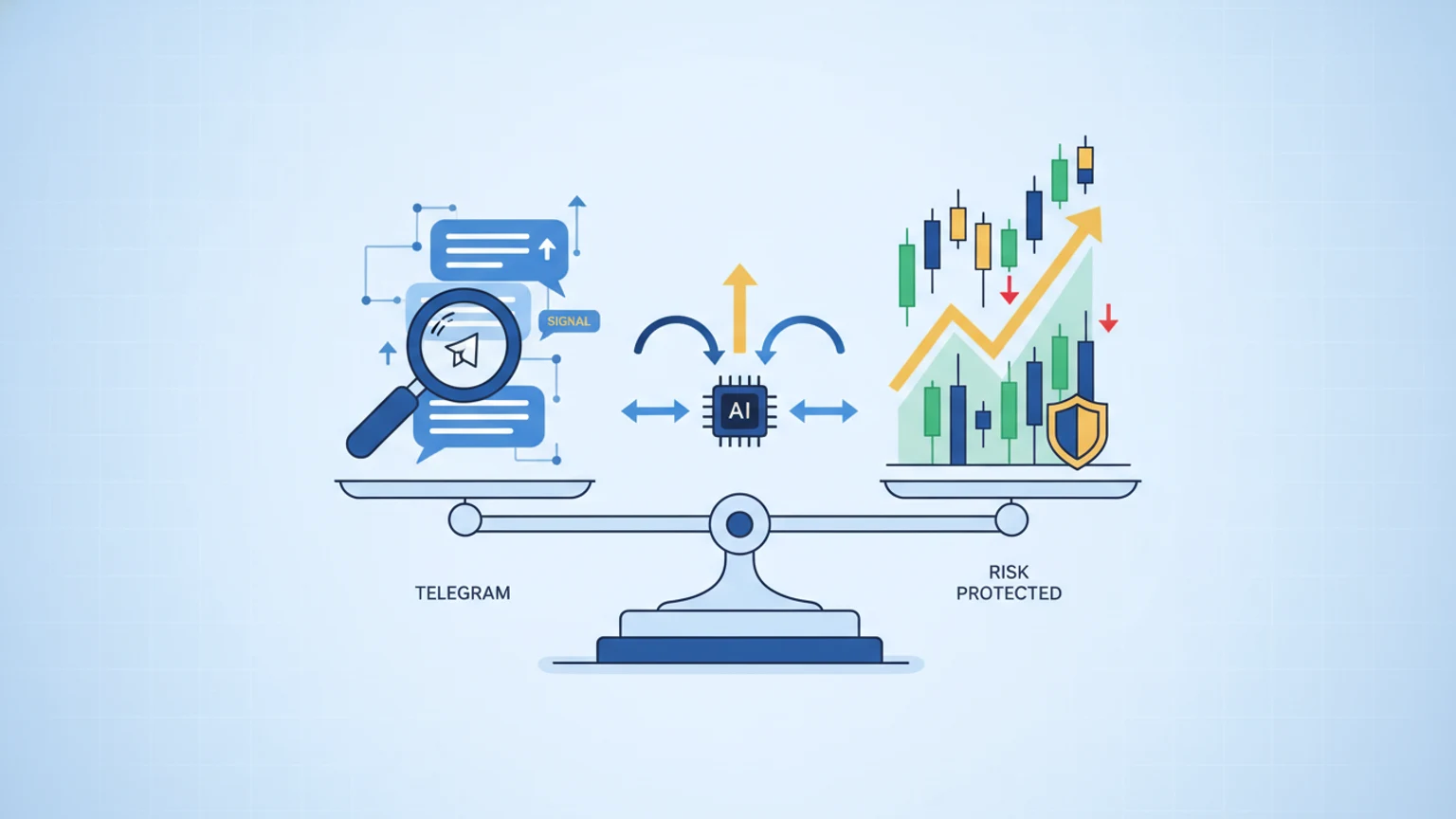
Yes, you can make money copying Telegram signals - but it is not the default outcome, and the reason most people fail has little to do with the signals themselves. Profitability is decided by three things: whether the channel has a real, verified edge; how much you risk per trade; and how cleanly the trades are executed. Get those right and copying is a legitimate, hands-off way to trade. Get them wrong - which most people do - and you inherit the base rate of retail trading, where between 74% and 89% of accounts lose money (the risk-warning range EU brokers publish under ESMA's product-intervention measures). This guide is the honest version: the math, the failure modes, and the few levers that actually move the odds.
Let us be clear up front about what this article is not. It is not a list of "guaranteed profitable" channels, and it does not promise a number. Telegram passed 1 billion monthly active users in March 2025 (Telegram), and a large slice of the trading channels among them publish screenshots that are cherry-picked, edited after the fact, or outright fabricated. The opportunity is real; so is the noise. The job is to tell them apart.
The short answer, with the math
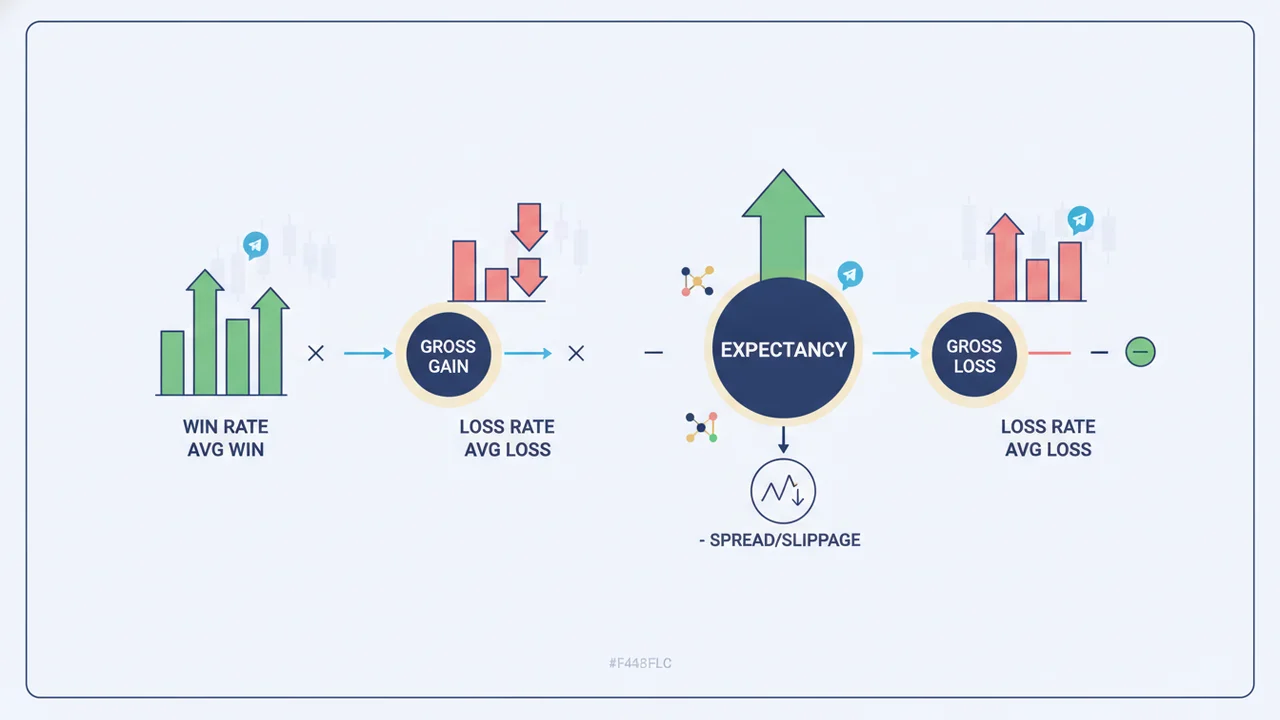
Copying signals is profitable when your expectancy is positive after costs. Expectancy is the average outcome per trade: (win rate x average win) - (loss rate x average loss). A channel can win 70% of the time and still lose you money if its losers are three times the size of its winners. It can win 45% of the time and make money if its winners run. The headline win rate that channels advertise tells you almost nothing on its own.
"It's not whether you're right or wrong that's important, but how much money you make when you're right and how much you lose when you're wrong." - George Soros
That quote is the whole game. A copier inherits the provider's expectancy and then subtracts its own frictions - spread, slippage, and any swap or commission. If the underlying edge is thin, those frictions alone can flip it negative. This is why the same signal channel can be marginally profitable for the provider trading a raw spread account and a net loser for a follower on a wider-spread broker copying a few seconds late.
What our own backtests show
We do not have to guess at this, because we replay our users' channels on real price data. Here is the snapshot taken on 15 September 2026, covering 235 signals from 13 channels posted between January and September 2026, replayed on 1-minute candles:
| Measure | Result |
|---|---|
| Signals backtested | 235 across 13 channels |
| Completed trades (win, partial win or loss) | 134 |
| Completed trades that finished positive | 40.3% |
| Pooled result of copying every completed trade at equal risk | -9.32R |
| Channels with enough completed trades to score | 10 |
| Of those, channels with positive expectancy | 4 |
| Median channel expectancy | -0.14R per trade |
Read the median line carefully: the typical channel in that sample loses fourteen hundredths of one R on every trade it posts. It is not a catastrophe per trade - it is a slow, grinding negative edge that a 60%-win-rate screenshot hides completely. And four channels were profitable, which is the other half of the honest answer: the distribution is real, the average is negative, and picking is everything.
The full method, the per-channel table and the SQL behind every number are in we backtested 13 Telegram signal channels.
What actually decides whether you profit
Four variables determine the outcome. In rough order of impact:
| Factor | Why it matters | What good looks like |
|---|---|---|
| Verified channel edge | A real, positive expectancy is the only source of profit | Track record backtested against actual market data, not screenshots |
| Risk per trade | Controls how long you survive a losing streak | A fixed 0.5%-1% of equity, sized from your account |
| Execution quality | Slippage and spread erode thin edges | Fast, automated entry; sensible broker; realistic stops |
| Your own discipline | Skipping or overriding signals breaks the edge | Copy the system as designed, or do not copy it |
Notice what is not on the list: the subscription price, the size of the channel's follower count, or how confident the messages sound. None of those predict profit. The first row - a verified edge - is the one almost nobody checks, which is exactly why it is where most money is lost.
1. Does the channel actually have an edge?
Most published track records are unverifiable. A channel can delete losing calls, edit a stop-loss after price moved, or post a "closed +120 pips" with no way to confirm the entry ever existed. The only honest way to know whether a provider has an edge is to reconstruct its called trades against real historical price data and measure what a follower would actually have made. That is the entire premise of channel forensics and AI-based provider verification: treat the channel's claims as a hypothesis and test it against the tape before you risk a cent.
Real-Time Signal Analysis
Watch how we verify every signal against actual market data
2. How much are you risking per trade?
This is the single biggest controllable variable. Copying a provider's stated lot size is the classic mistake - "2 lots" is sized for their account, not yours. Size every position as a fixed percentage of your equity instead. At 1% risk per trade, it takes a punishing run of losers to do real damage; at 5%, a single bad cluster can erase a month. The provider controls the signals; you control survival, and survival is what compounds.
3. Are slippage and spread quietly eating the edge?
A signal that looks great on the channel can arrive at your broker a few seconds and a few pips worse. On a scalping channel targeting 8-12 pips, two pips of spread plus a pip of slippage is a 25-40% tax on every winner. This is why execution speed and broker choice matter more than they seem, and why automated copying generally beats manual entry - not because automation is magic, but because a human reading, calculating a lot size, and clicking is slower and more error-prone than a system that fires in milliseconds.
4. Will you actually follow the system?
A channel's track record assumes you take every signal at the stated risk. The moment you skip "the ones that look risky," move a stop because you are nervous, or add to a loser out of hope, you are no longer trading the channel's edge - you are trading your emotions with the channel as cover. Either copy the system faithfully (which usually means automating it) or accept that the published numbers no longer apply to you.
Why most copy traders lose
Put the four factors together and the common failure pattern is predictable. A trader finds a channel with attractive screenshots, subscribes, copies the provider's lot sizes at 3-5% effective risk, executes manually a few seconds late on a wide-spread broker, and overrides the system the first time it draws down. Each decision shaves the edge; together they guarantee the base rate. The signals were never independently verified, so there may have been no edge to begin with.
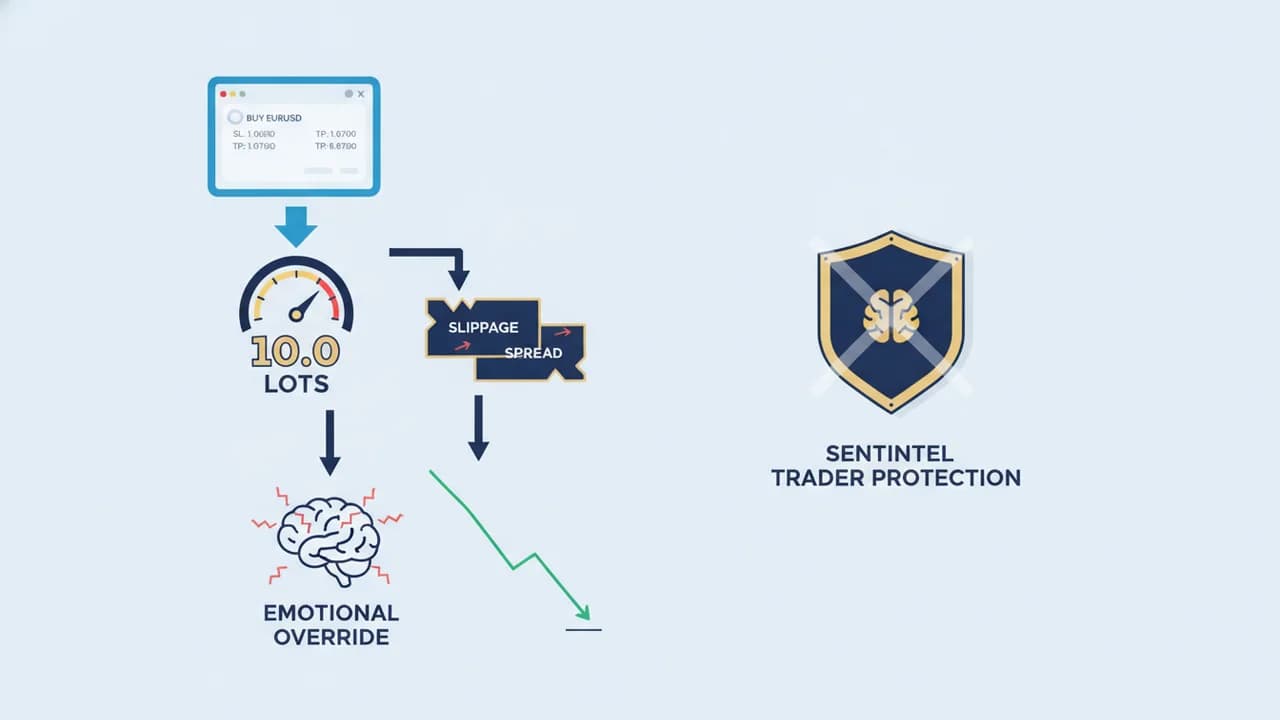
The prop-firm world makes this measurable. An FPFX Technologies study of more than 300,000 prop accounts found that 14% passed the evaluation and only about 7% of traders ever took a payout (Finance Magnates). Risk management, not signal quality, is the wall most accounts hit. Copying signals onto a funded account without a hard risk guard simply automates the breach.
How to tilt the odds in your favour
The levers that actually matter are unglamorous and entirely within your control:
- Verify before you copy. Reconstruct the channel's real called trades against market data and look at follower-realistic results, including spread and slippage. If a provider's edge does not survive verification, no amount of position sizing will save it. Start with the safety checklist and a short list of reputable channels.
- Size from your own equity. Fix risk at 0.5%-1% per trade and let the copier translate that into the correct lot for each signal. Never mirror the provider's volume.
- Automate execution. Remove the seconds and the hesitation. A Telegram-to-MT5 copier fires every signal at the same risk, the same way, without you watching the chart.
- Add a screening layer. Optional AI signal screening can shrink or reject borderline signals that do not fit your risk profile, so a single bad call from an otherwise good channel does less damage.
- Diversify across vetted channels. One channel is a single point of failure. A few independently verified channels smooth the equity curve - provided you are not secretly stacking correlated trades (long EURUSD and long GBPUSD at once is one position, not two).
None of these turn a bad channel good. They make a genuinely profitable channel survivable and copyable, which is the only situation where money is actually made.
What "realistic" returns look like
Here is the honest range. A vetted channel copied with disciplined risk produces single-digit to occasionally low-double-digit percentage months in good periods, interleaved with flat and losing months. Compounded over a year with strict risk control, that is a respectable result - and nothing like the marketing.
| Expectation | Marketing claim | Honest reality | What our data shows |
|---|---|---|---|
| Monthly return | "Double your account every month" | Low single digits to low double digits in good months; losing months happen | Pooled result across 134 completed trades: -9.32R |
| Win rate | "90%+ win rate" | A high win rate often hides large losers; expectancy matters more | Median scored channel win rate: 31% |
| Consistency | "Profit every week" | Edges come in clusters; drawdowns are normal, not a malfunction | 4 of 10 scored channels had positive expectancy |
| Effort | "Fully passive, set and forget" | Passive execution, yes - but you still choose and monitor the channel | 107 of 120 monitored channels have never been backtested by their own subscriber |
If a channel or tool promises guaranteed or extreme consistent returns, treat the promise itself as the red flag. Real edges are modest and lumpy; the people selling certainty are selling the certainty, not the performance.
So - can you make money?
Yes, with conditions. Copying Telegram signals is profitable for the minority who copy a verified channel, risk a small fixed percentage per trade, execute cleanly and automatically, and follow the system instead of overriding it. It is unprofitable for the majority who do the opposite. The act of copying is neutral; it faithfully amplifies whatever edge - or lack of one - sits behind the channel, minus your costs.
That is exactly the gap Telegram AI Trader is built to close. It copies Telegram signals onto MT5 with no VPS, sizes every trade from your own equity, runs optional AI screening and channel forensics so you copy verified edges rather than screenshots, and guards funded accounts against a breach. It cannot invent an edge that is not there - nothing can - but it removes the execution, sizing, and verification mistakes that turn even good channels into losing accounts. For the full discipline framework, see our risk-management guide.
See pricing or start a free trial to copy vetted Telegram signals onto MT5 with risk controls built in - and decide for yourself, on a verified channel and small risk, whether the edge is real.
Frequently Asked Questions
Can you actually make money copying Telegram signals?
Yes, it is possible, but it is not the default outcome. Profitability depends far more on the channel's real (verified) edge, your risk per trade, and clean execution than on the act of copying itself. Most people lose because they copy an unverified channel at oversized risk and let slippage and spread erode a thin edge. Vet the channel against real market data, risk a fixed small percentage per trade, and automate execution, and copying becomes a legitimate - if modest - way to trade hands-off.
What percentage of Telegram signal copiers are profitable?
There is no clean public figure specific to Telegram copiers, but the base rate is sobering: between 74% and 89% of retail trading accounts lose money according to ESMA broker disclosures. Copying a signal does not change that math - it inherits it. The traders who end up profitable are the minority who copy a genuinely profitable provider with disciplined position sizing, not the majority chasing screenshots of 90% win rates.
Why do most people lose money copying Telegram signals?
Four reasons dominate: copying a channel whose track record is inflated or unverified; risking too much per trade so one losing cluster wipes weeks of gains; slippage and spread quietly turning a small edge negative; and emotional interference - skipping signals, moving stops, or doubling down. The signals are rarely the whole problem; the way they are copied usually is.
How much money can you realistically make copying signals?
Realistic expectations for a vetted channel and disciplined risk are single-digit to low-double-digit percentage returns per month in good periods, with losing months mixed in - not the doubling-every-week claims in marketing. Anyone promising guaranteed or extreme consistent returns is selling the promise, not the performance. Treat steady, survivable growth as the goal, not a get-rich-quick outcome.
Are paid Telegram signals more profitable than free ones?
Not automatically. Price signals marketing spend, not edge. Some paid channels are excellent and some free ones are solid; plenty of expensive channels are unprofitable once you account for spread and slippage. The only reliable filter is verified performance - backtesting the channel's actual called trades against real market data - rather than the subscription price or the screenshots in the pinned message.
Ready to Automate Your Trading?
Join traders who never miss a signal. Start with a free trial and see the difference AI-powered automation makes.
Continue Reading
Copy Telegram Signals to MT5: Complete Setup Guide
Step-by-step guide to connect Telegram channels to MetaTrader 5.
Read moreResourcesBest Forex Signal Telegram Channels
Curated list of reliable forex signal channels for 2026.
Read moreAsset GuideGold XAUUSD Trading Signals Guide
Everything you need to know about gold trading signals on Telegram.
Read more