Forex Lot Size & Position Sizing for Signal Copying (2026)
How to size forex trades correctly when copying signals - lot sizes explained, the position-sizing formula with worked examples, why copying a provider's lot size is the biggest mistake, and how pip value changes across pairs and gold.
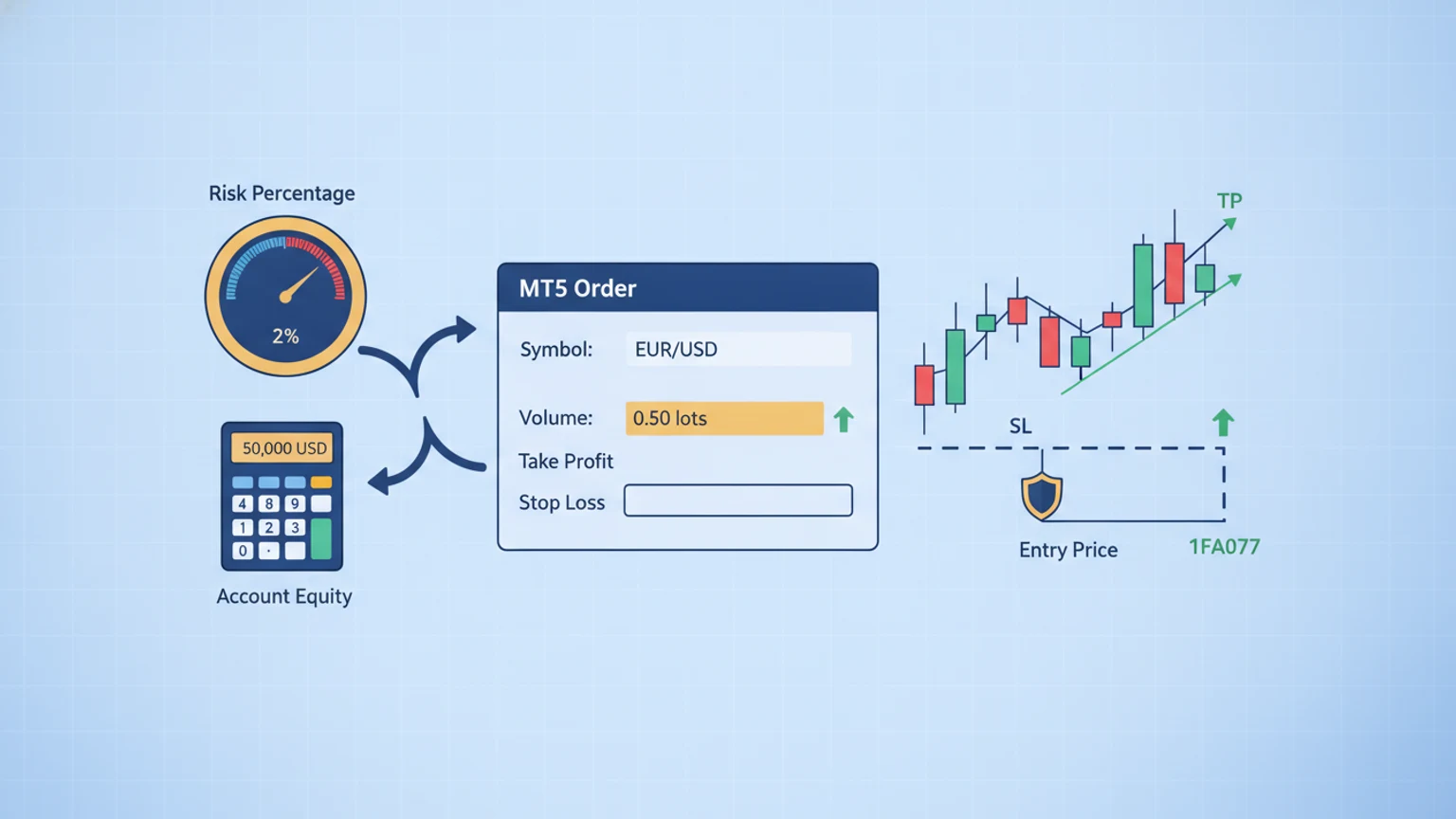
When you copy a forex signal, the most important number is not the entry - it is your lot size, and you should never take it from the signal. Size every trade from a fixed percentage of your own equity using one formula: lot size = account risk in dollars / (stop-loss in pips x pip value). A provider's "2 lots" is sized for their account, not yours; copying it blindly is the fastest way to over-risk or under-risk every trade. This guide explains lot sizes and pip value, walks through the position-sizing formula with worked examples, and shows how a copier sizes each trade automatically so your risk stays constant.
Position sizing is where most accounts are won or lost. The entry decides whether a trade wins; the size decides whether a losing streak is survivable. With between 74% and 89% of retail accounts losing money (the risk-warning range EU brokers publish under ESMA's product-intervention measures), the difference between the survivors and the rest is rarely signal quality - it is disciplined, equity-based sizing applied to every single trade.
Lot sizes and pip value, explained
A lot is the unit of position size. There are three you will meet:
- Standard lot = 100,000 units of the base currency (~$10 per pip on USD-quoted pairs)
- Mini lot = 10,000 units, written 0.1 lots (~$1 per pip)
- Micro lot = 1,000 units, written 0.01 lots (~$0.10 per pip)
A pip is the standard price increment - the fourth decimal on most pairs (0.0001), or the second decimal on JPY pairs (0.01). Pip value is what one pip is worth on your position: for a standard lot on EUR/USD, roughly $10. Position sizing is simply choosing how many lots to trade so that, if your stop-loss is hit, you lose only the amount you intended.
"The essence of risk management lies in maximizing the areas where we have some control over the outcome while minimizing the areas where we have absolutely no control." - Peter Bernstein
You cannot control whether a trade wins. You can control its size - which is why position sizing, not prediction, is the core of risk management.
The position-sizing formula
Every correctly sized trade comes from the same calculation:
Lot size = (Account balance x Risk %) / (Stop-loss in pips x Pip value per lot)
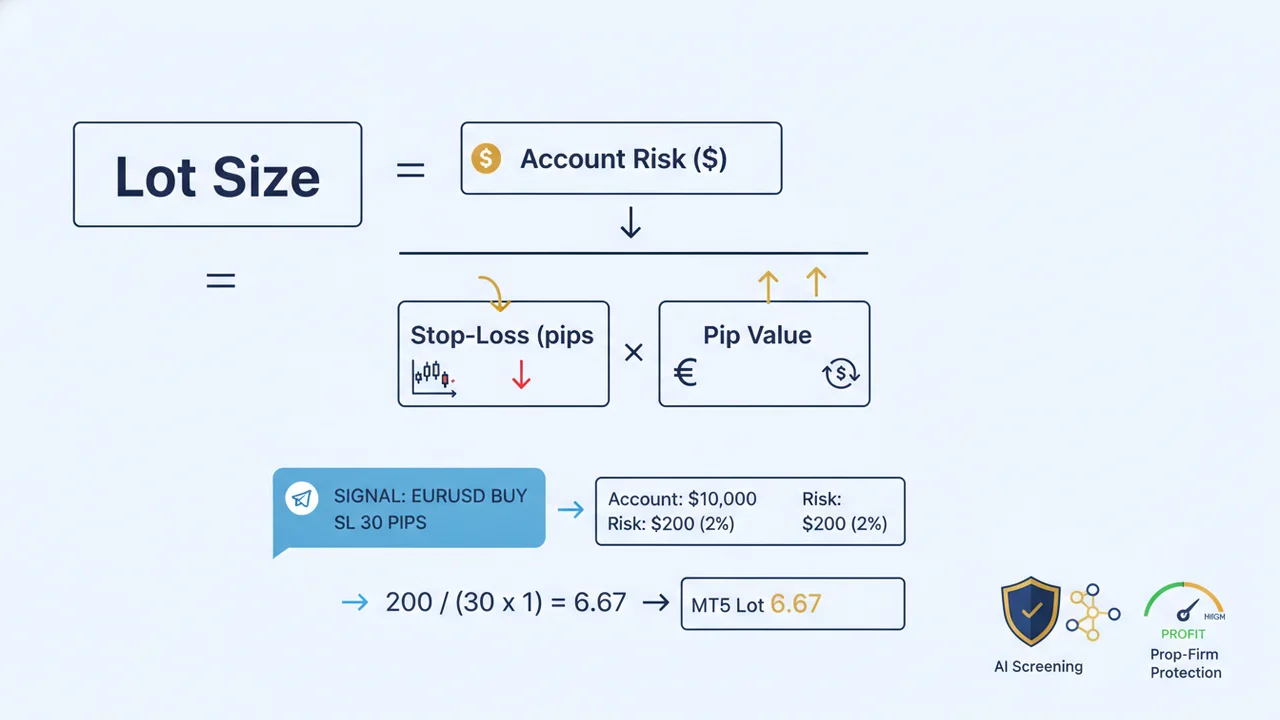
Work it in three steps:
- Dollar risk = account balance x your risk percentage. A $10,000 account risking 1% = $100.
- Risk per lot = stop-loss in pips x pip value per lot. A 20-pip stop on EUR/USD at $10/pip = $200 per standard lot.
- Lot size = dollar risk / risk per lot = $100 / $200 = 0.5 lots.
That 0.5-lot position loses exactly $100 if the stop is hit - your intended 1%. Change any input and the lot size changes; the risk stays fixed. This is the whole point: the formula holds your risk constant while the market, the stop distance, and the signal all vary.
Worked examples
The same approach scales to any account and stop distance. Note how the lot size moves to keep the dollar risk consistent:
| Account | Risk % | Dollar risk | Stop-loss | Pip value (1.0 lot) | Lot size |
|---|---|---|---|---|---|
| $5,000 | 1% | $50 | 25 pips | $10 | 0.20 |
| $10,000 | 1% | $100 | 20 pips | $10 | 0.50 |
| $10,000 | 0.5% | $50 | 50 pips | $10 | 0.10 |
| $25,000 | 1% | $250 | 30 pips | $10 | 0.83 |
Notice that a wider stop forces a smaller lot, not a bigger risk. A common error is to keep the lot size fixed and let a wider stop quietly multiply the loss. Correct sizing does the opposite - it shrinks the position so the dollar risk never changes.
Why copying the provider's lot size is the biggest mistake
A Telegram signal that says "Buy EUR/USD, 2 lots" is telling you the provider's position, sized for their balance and risk appetite. Apply it to your account and one of two bad things happens: if your account is smaller, 2 lots is a reckless share of your equity; if it is larger, you are under-risking and the strategy barely moves your account. Either way, your risk is now random.
This is the most frequent reason copy traders blow up, and it is entirely avoidable. Size from your own equity, every time. The provider supplies the entry, stop, and targets; you supply the position size based on your balance and the stop distance. For the wider framework, see our risk-management guide and the honest economics in can you actually make money copying Telegram signals.
Pip value changes across pairs - and gold is different
Pip value is not universal, which is another reason fixed-lot copying is dangerous across instruments.
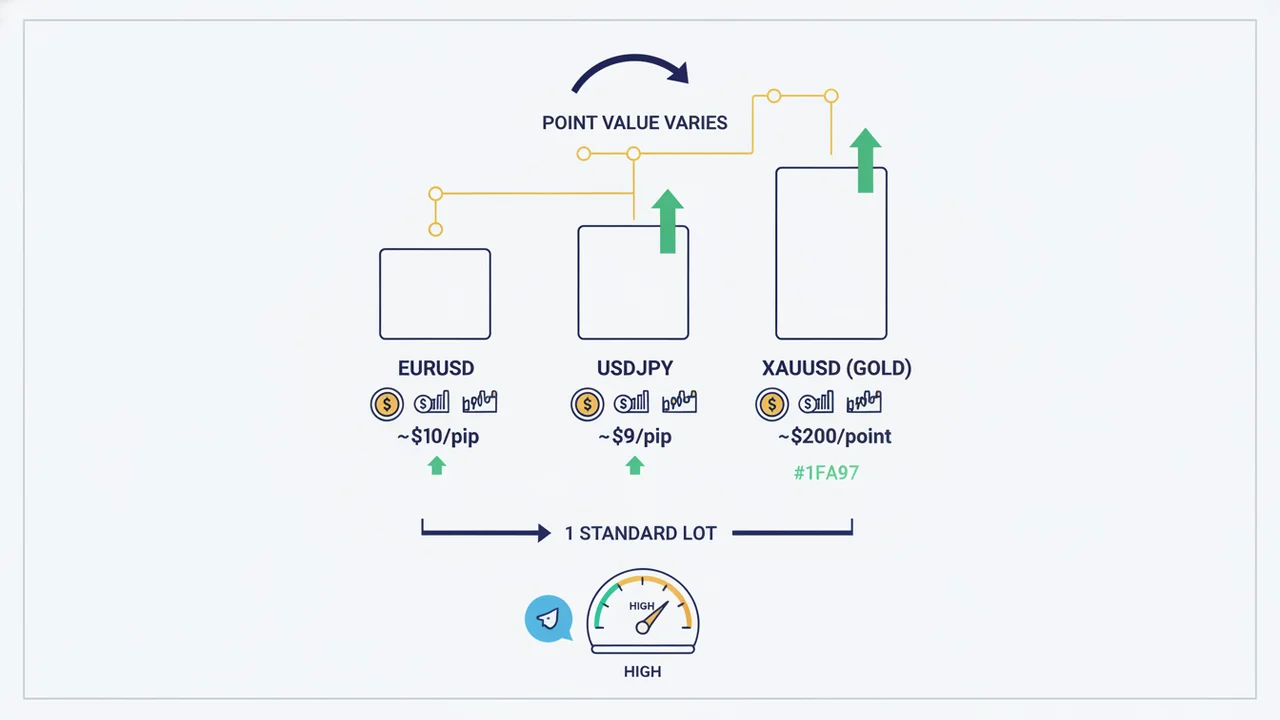
- USD-quoted majors (EUR/USD, GBP/USD, AUD/USD): about $10 per pip per standard lot.
- JPY pairs (USD/JPY, EUR/JPY): a pip is the second decimal (0.01); pip value is similar in dollar terms but calculated differently, so let your platform compute it.
- Gold (XAUUSD): the big one. A standard lot is typically 100 ounces, so a $1.00 move is around $100 per lot - a completely different scale from a forex pair. Gold's larger moves and value per point mean a lot size that is sensible on EUR/USD can be far too large on gold. Always size gold from its own pip/point value, as we cover in the gold (XAUUSD) trading signals guide.
The lesson: the same "0.5 lots" carries very different risk on EUR/USD versus XAUUSD. Size per instrument, from its real pip value and your stop.
Total exposure: sizing across multiple trades
Per-trade sizing is only half the job; total exposure is the other half. Five trades each risking 1% can mean 5% at risk simultaneously - and if they are correlated (long EUR/USD and long GBP/USD are effectively the same bet), your real exposure is larger than it looks. When copying several channels, cap your combined open risk, not just each trade, or a single market move can hit every position at once. Worth knowing where the tooling stops: Telegram AI Trader caps total exposure as a maximum share of margin used and enforces a daily-loss percentage, but it does not detect correlation between symbols. Deciding that a EURUSD long and a GBPUSD long are one bet is still your job. This matters most on prop-firm accounts, where stacked correlated trades are a classic path to a daily-loss breach - an FPFX Technologies study of more than 300,000 prop accounts found that 14% passed the evaluation and only about 7% of traders ever took a payout (FPFX Technologies data reported by Finance Magnates).
Position sizing on prop-firm accounts
Funded accounts demand tighter sizing because the loss limits are hard lines. With a 5% daily-loss limit, 1% per trade gives you about five losers of room before a breach; 0.5% gives you ten; 0.25% gives you twenty. Most traders passing a prop-firm challenge use 0.25%-0.5% per trade precisely to survive the inevitable losing cluster. The downside of a breach is total; the upside of bigger size is small.
Fixed-lot vs fixed-percentage sizing
There are two ways to decide size, and only one scales safely:
- Fixed-lot sizing trades the same lot (say 0.20) on every signal regardless of stop distance or account balance. It is simple but blind: a 50-pip stop risks more than twice a 20-pip stop, and as your account grows or shrinks the risk percentage drifts. Worst of all, it is what you get if you copy the provider's lot - random risk on every trade.
- Fixed-percentage (fixed-fractional) sizing risks the same share of equity every time, so the lot adjusts to both the stop distance and your current balance. Your risk stays constant whether the stop is tight or wide, and the position naturally grows as you win and shrinks as you lose - the behaviour that lets a real edge compound while protecting capital in a drawdown.
For signal copying, fixed-percentage sizing is the default for a reason: it is the only model that keeps your risk intended rather than accidental. The minor cost - recalculating the lot for every signal - is exactly the work a copier removes.
How a copier sizes every trade automatically
How Signal Copying Works
Automatic flow from Telegram to your MT5 account
Doing this math by hand on every signal is slow and error-prone - which is exactly why a good copier automates it. Telegram AI Trader reads each signal's stop-loss, takes your chosen risk percentage, computes the correct lot for your equity and the instrument's pip value, and places the trade at that size - never the provider's. It enforces equity-based sizing across crypto, forex, and gold alike, caps total exposure, and on funded accounts keeps every position inside your daily-loss and drawdown limits. The result is constant, intended risk on every trade without you touching a calculator. For setup, see how to copy Telegram signals to MT5, and pair this with automatic stop-loss and take-profit.
The bottom line
Lot size is the lever that decides whether a losing streak is a dip or a disaster. Never copy a provider's lot size; instead, fix your risk at a small percentage of your own equity and size each trade with the formula - dollar risk divided by stop-loss times pip value. Remember that pip value changes across pairs and is in a different league on gold and silver, cap your total exposure as well as each trade, watch for correlation yourself, and tighten sizing further on funded accounts. If you would rather not do the arithmetic by hand, our free lot-size calculator does it in the browser. Get position sizing right and a genuine edge can compound safely; get it wrong and even the best signals will not save the account.
See Telegram AI Trader pricing or start a free trial to copy Telegram signals to MT5 with automatic, equity-based position sizing on every trade.
Frequently Asked Questions
How do you calculate forex lot size for a signal?
Use this formula: lot size = account risk in dollars / (stop-loss in pips x pip value per lot). First decide your risk as a fixed percentage of your account, say 1%. Multiply your balance by that to get the dollar risk. Then divide by the stop-loss distance in pips times the pip value. For a $10,000 account risking 1% ($100) with a 20-pip stop on EUR/USD (about $10 per pip per standard lot), the size is 100 / (20 x 10) = 0.5 lots. The same signal on a different account gives a different lot size.
Should I copy the lot size from a Telegram signal?
No - this is the single most common and damaging mistake in signal copying. A signal that says '2 lots' is sized for the provider's account balance and risk tolerance, not yours. Copying it blindly can mean risking a tiny fraction of your account or, far worse, a huge chunk of it. Always size every trade from a fixed percentage of your own equity using the stop-loss distance, and let your copier do the calculation automatically.
What is a lot in forex?
A lot is the position size unit. A standard lot is 100,000 units of the base currency, a mini lot is 10,000 (0.1 lots), and a micro lot is 1,000 (0.01 lots). On most USD-quoted pairs, a standard lot is worth roughly $10 per pip, a mini lot $1 per pip, and a micro lot $0.10 per pip. Position sizing is simply choosing how many lots to trade so that, if your stop-loss is hit, you lose only your intended risk amount.
How much should I risk per trade when copying signals?
Most disciplined traders risk a fixed 0.5% to 1% of account equity per trade, and many prop-firm or multi-channel copiers go as low as 0.25%. The goal is to survive a string of losers without serious damage. At 1% risk it takes a painful run to do real harm; at 5% a single bad cluster can end your account. Lower, consistent risk is what lets a genuine edge compound over time.
Does pip value change between currency pairs?
Yes. Pip value depends on the pair and your account currency. USD-quoted pairs like EUR/USD and GBP/USD are about $10 per pip per standard lot, JPY pairs are similar but calculated differently because a pip is the second decimal, and gold (XAUUSD) is different again - one standard lot is typically 100 ounces, so a $1 move is around $100. Because pip value varies, the same lot size means very different risk across instruments, which is exactly why fixed-lot copying is dangerous.
Ready to Automate Your Trading?
Join traders who never miss a signal. Start with a free trial and see the difference AI-powered automation makes.
Continue Reading
Best Prop Firm Risk Management Tools (2026)
A 2026 guide to the best prop firm risk management tools: automated equity guards, sizing calculators, and journals that stop a funded account from breaching its limits.
Read moreComparison7 Best TelegramFxCopier Alternatives (2026)
The seven best TelegramFxCopier alternatives for 2026, compared on platform support, AI features, prop-firm safety, and pricing.
Read moreProp Firm TradingFundedNext Rules Explained for Automated Signal Traders (2026)
A clear 2026 guide to FundedNext's rules - Stellar one-step and two-step models, profit targets, daily-loss and drawdown limits, and consistency - for automated signal traders.
Read more