FundedNext Rules Explained for Automated Signal Traders (2026)
Every FundedNext rule explained for traders who copy Telegram signals: the Stellar one-step and two-step models, profit targets, the daily-loss and max-drawdown limits, the consistency rule, and how to automate compliance.
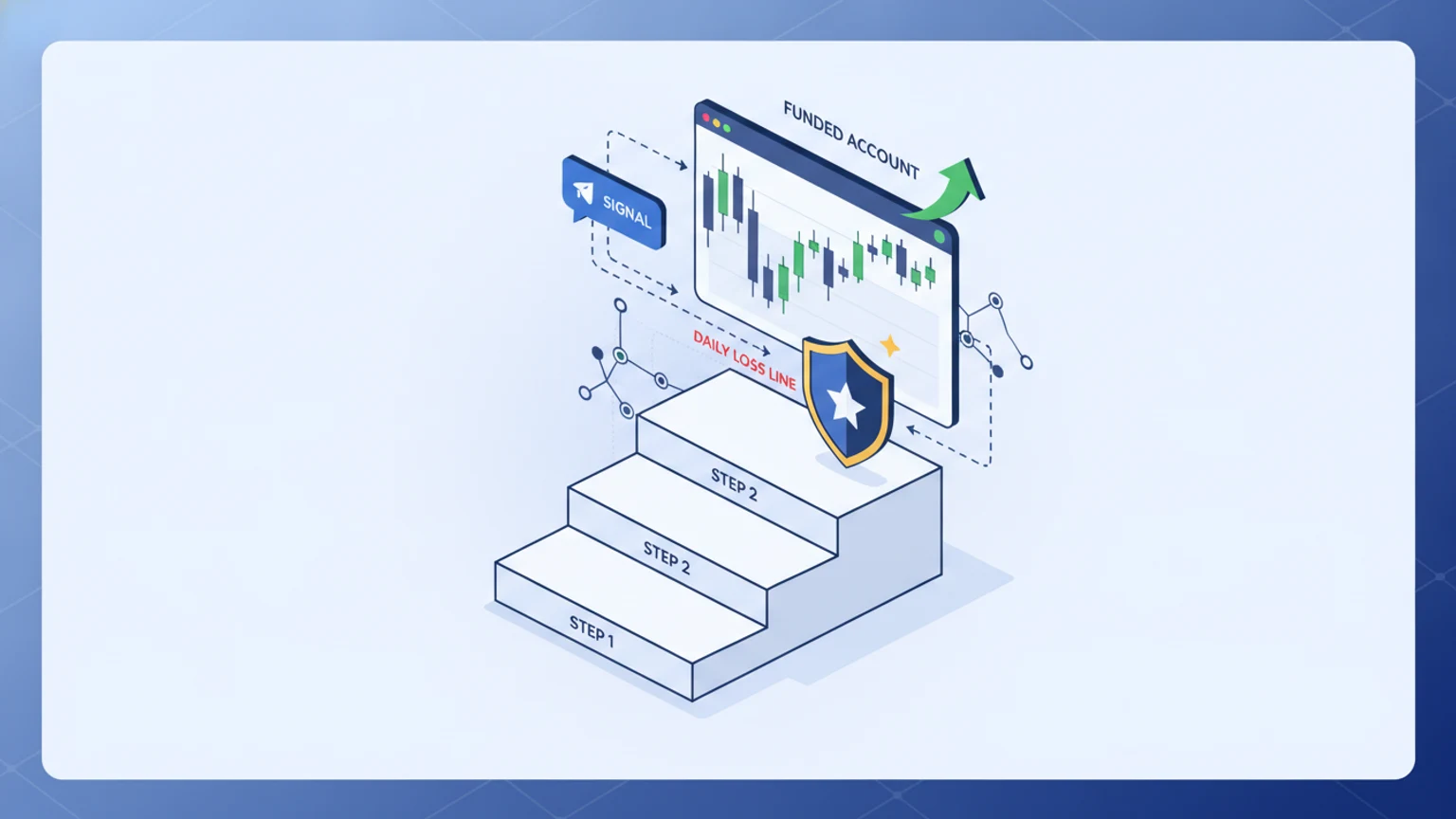
FundedNext's rules come down to four things: a profit target, a daily-loss limit, an overall maximum-drawdown limit, and a consistency rule. Hit the target without ever breaching a loss line and you keep the funded account; cross a loss limit a single time and the evaluation ends, no matter how good your signals were. For traders copying Telegram signals onto a FundedNext account, the rules themselves are rarely the obstacle - staying inside the loss limits while you wait for a good run of trades is. This guide explains every current FundedNext rule in plain language, focuses on its Stellar models, and shows how to automate compliance so one bad session never ends your challenge.
A note before the numbers: prop-firm terms change, and FundedNext runs several account types. The figures below are the standard Stellar Challenge values at the time of writing; always confirm the exact limits for your chosen model on FundedNext's website before you trade. The principles - how the limits work and how to stay inside them - do not change.
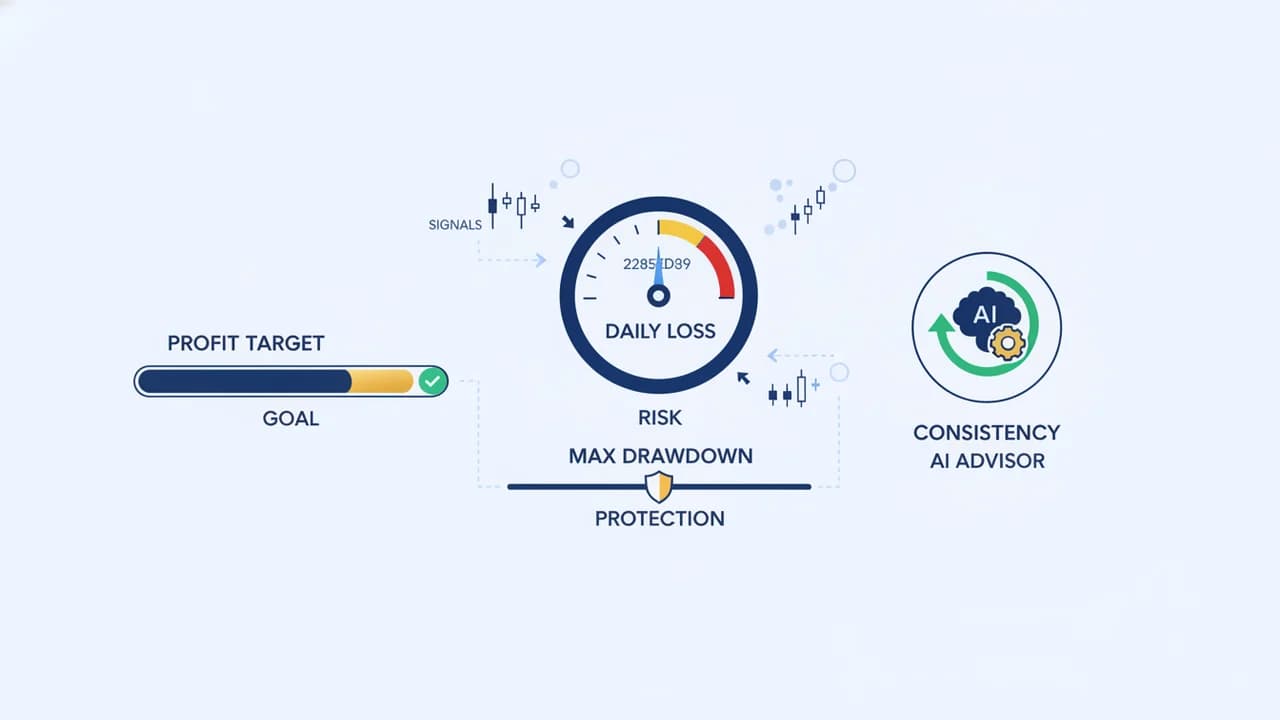
How FundedNext is structured
FundedNext is a proprietary trading firm that funds traders who pass an evaluation on a simulated account. Its flagship is the Stellar program, offered in four formats: the Stellar 2-Step (evaluation, verification, then funding), the Stellar 1-Step (a single evaluation), Stellar Lite (a lower-cost two-phase account with tighter limits) and Stellar Instant (funded immediately, with no target and a trailing drawdown instead). The trade-off is familiar across the industry: fewer steps mean faster funding but tighter loss limits.
FundedNext's best-known differentiator is that it can reward you during the challenge itself - it has historically paid a share of profits made in the evaluation phase, not just after funding - and offers a high profit split (up to 95%) once funded. That is attractive, but it does not change the core discipline: the loss limits are what decide whether you ever get there. Opportunity is never the scarce resource - account survival is.
| Objective | Stellar 2-Step | Stellar 1-Step | Stellar Lite | Stellar Instant |
|---|---|---|---|---|
| Profit target | 8% then 5% | 10% | 8% then 4% | None - funded immediately |
| Daily loss limit | 5% of initial balance | 3% | 4% | None |
| Maximum loss | 10%, static | 6%, static | 8%, static | 6%, trailing |
| Minimum trading days | 5 | 2 | 5 | None |
| Profit split | 80% standard, up to 90% with Scale-Up, up to 95% with the Add-On, plus a 15% challenge-phase reward | Same | Same, without the challenge-phase reward | Same |
Verified 15 September 2026 against the FundedNext Trading Objectives page. Prop-firm terms change; confirm the figures for your own model before you trade.
Two patterns to internalise. The 1-Step funds you faster but gives you barely half the daily room of the 2-Step and a 6% total floor instead of 10% - it is the tightest of the four for anyone copying clustered signals. And Stellar Instant is the odd one out: no daily limit at all, but a trailing 6% maximum loss that follows your equity up, which behaves very differently from the static floors on the other three.
Rule 1: The profit target
The profit target is the gain you must reach to pass, calculated on your starting balance. On the two-step Stellar it is 8% in Phase 1 and 5% in Phase 2; on the one-step it is a single 10%. Once funded, there is no target - you simply trade and take payouts. The target is deliberately the least dangerous rule, because reaching it is a function of time and consistency rather than a single risky moment.
The classic mistake is treating the target as a deadline and oversizing to hit it quickly. There is no reward for speed and a total penalty for a breach, so let the target come to you. At a conservative 0.5-1% of equity per good day, an 8-10% target is a few weeks of steady trading, not one lucky session.
Rule 2: The daily-loss limit
The daily-loss limit is the rule that ends most challenges. On the Stellar 2-Step it is 5% of your initial balance; on the 1-Step 3%, on Lite 4%, and Stellar Instant has none. Critically, FundedNext measures your account in real time, so the limit counts floating (open) losses as well as closed ones. If your equity at any point in the day sits the full 5% (or 3%) below the day's reference balance, the rule is breached - even if the position later recovers.
A worked example on a $100,000 two-step account: your daily floor is $95,000. If you are down $3,000 in closed trades and holding a position floating at -$2,100, your equity is $94,900 and the account has failed - the floating loss counted. The defence is a buffer: set your own internal daily stop below the firm's hard line (around 4% if the limit is 5%) and stop trading for the day when you reach it, with open positions flattened.
"The elements of good trading are cutting losses, cutting losses, and cutting losses."
- Ed Seykota, quoted in Jack D. Schwager, Market Wizards
Pre-Trade Breach Check
Every signal is checked against your firm's limits before it can execute
Rule 3: The maximum drawdown
The maximum drawdown is the lowest your account may ever fall. On the two-step Stellar it is 10% of your starting balance; on the one-step it is 6%. Unlike the daily limit, which resets each day, the maximum drawdown is the static floor for the whole evaluation. On a $100,000 two-step account, equity must never touch $90,000, whether that drop happens in a single day or accumulates over weeks.
In practice the daily limit usually triggers first and protects you from the overall floor. But a string of losing days, each within the daily limit, can still walk you into the maximum drawdown - which is why per-trade sizing matters as much as the daily stop. The two rules work together:
| Rule | On a $100k 2-step account | Resets? | Counts floating P&L? |
|---|---|---|---|
| Daily loss (5%) | Equity floor of $95,000 that day | Yes, daily | Yes |
| Maximum drawdown (10%) | Equity floor of $90,000, always | No - static | Yes |
Always confirm whether your specific model uses a static or trailing maximum drawdown, as this differs across FundedNext account types and affects how much room you have as the account grows.
Rule 4: The consistency rule
FundedNext applies a consistency rule on its models so that no single day's profit makes up too large a share of your total profit. The intent is to reward steady traders rather than someone who got lucky on one oversized day. The exact threshold depends on the model and is shown in your dashboard, but the practical takeaway is simple: trade similar risk each day and spread your gains across several sessions, and you will stay well clear of it. Consistency rules tend to catch traders who hit the target in one or two huge trades - exactly the behaviour that also risks a breach.
The rules that quietly fail copy traders
Most FundedNext failures are not exotic violations - they are ordinary risk mistakes amplified by automation. An FPFX Technologies study of more than 300,000 prop accounts found that 14% passed the evaluation and only about 7% of traders ever took a payout (Finance Magnates). A copier makes this worse if it mirrors a provider blindly, and better if every signal is sized from your own rules.
- Copying the provider's lot size. A signal that says "2 lots" is sized for the provider's account, not yours. Always size from a fixed percentage of your equity.
- Stacking correlated trades. Long EURUSD and long GBPUSD at once is effectively one larger position; a copier running several channels can quietly double your real exposure.
- No automated daily stop. Manual discipline fails during the exact news spike that gaps the market through your mental stop.
- Grid and martingale channels. Strategies that add to losers are structurally designed to breach a drawdown rule eventually, no matter how good the win rate looks.
For the full framework, see our risk-management guide for signal traders, and compare the tools that enforce these limits.
Position sizing that keeps you inside the limits
Risk per trade turns a 5% daily limit into a survivable buffer instead of a trap. A copier should never mirror the provider's volume; it should size every position from a fixed percentage of your equity. The table below shows how per-trade risk translates into daily headroom against a 5% daily-loss limit.
| Risk per trade | Losers before daily breach | Suits | Trade-off |
|---|---|---|---|
| 1.0% | ~5 trades | Few high-conviction signals | One bad cluster can end the day |
| 0.5% | ~10 trades | Most challenge traders | Balanced survival vs. speed |
| 0.25% | ~20 trades | High-frequency or multi-channel copying | Very hard to breach; slower to target |
For a FundedNext evaluation - especially the one-step with its 3% daily limit - 0.25%-0.5% per trade is the range most passing traders use. It is deliberately slower than personal-account trading, because the downside of a breach is total and the upside of speed is small.
Does FundedNext allow Telegram signals and automated copying?
Yes - FundedNext permits Expert Advisors, automated execution, and copied signals on both evaluation and funded accounts. What it restricts is a specific set of abusive patterns: pure latency or arbitrage strategies that exploit feed delays, and copying the same trades across many funded accounts to multiply a single edge. A single account copying one or two vetted channels with strict per-trade sizing is well within normal terms. As context, between 74% and 89% of retail trading accounts lose money (the risk-warning range EU brokers publish under ESMA's product-intervention measures), so FundedNext cares far more about how you manage risk than where your signals originate.
The theme is identical across firms - they care about risk discipline and not gaming the evaluation. If you trade at several firms, read each one's terms; the differences matter, as we cover in the prop-firm signal-trading guide and the best prop firms for automated trading comparison. FundedNext's rules are close to FTMO's, but the consistency rule and the profit-during-challenge feature are its own.
Automating FundedNext compliance
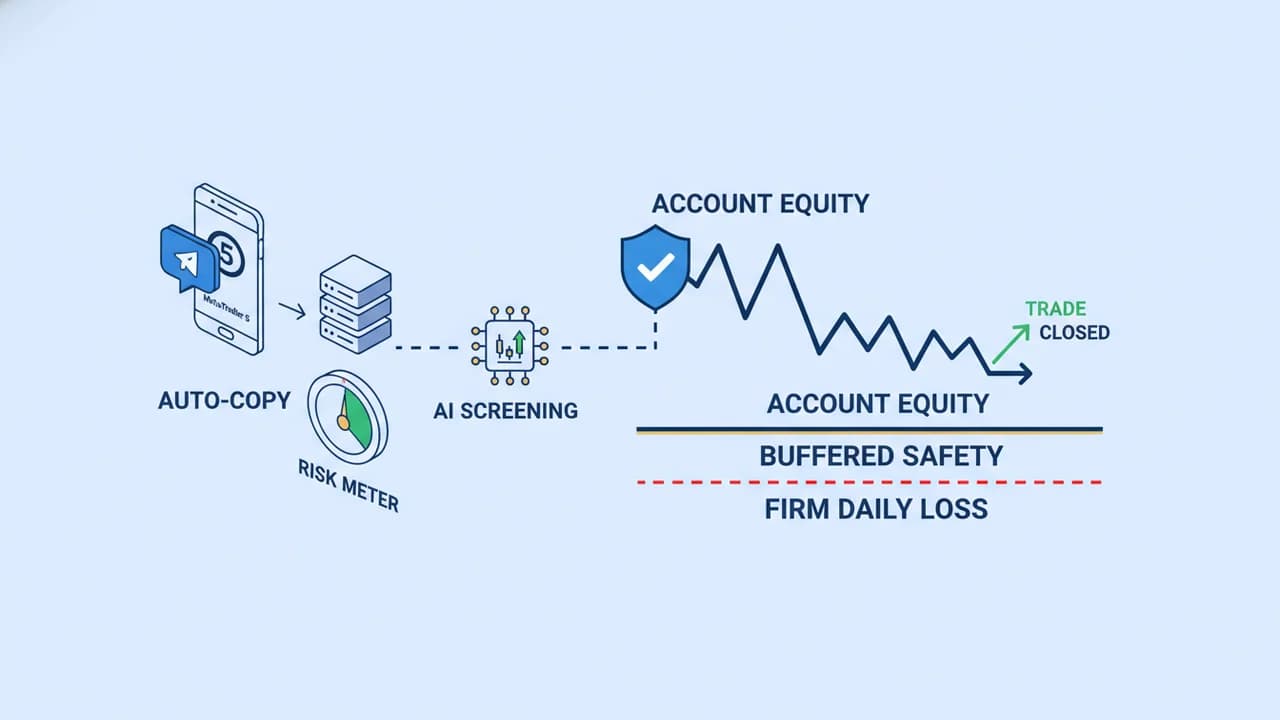
The most reliable way to stay clear of a FundedNext limit is to make the line hard to reach rather than relying on willpower. That means an equity-based guard that watches your account in real time and acts before a limit is hit - not an alert after the fact.
This is what Telegram AI Trader's PropFirmGuard does: it tracks live account equity and blocks new trades and closes open ones before your daily-loss or maximum-drawdown buffer is reached, on FundedNext, FTMO, The5ers, and E8 accounts. Combined with per-trade sizing from your own equity, optional AI signal screening that shrinks or rejects borderline signals, and channel forensics that vet a provider before you copy it, the limits stop being something you watch and become something the system enforces. For a step-by-step playbook, see how to pass a prop firm challenge using Telegram signals, and for why automation beats manual discipline here, manual vs automated trading.
The bottom line
FundedNext's rules are simple to state and unforgiving in practice: reach the profit target, stay above the daily floor, stay above the maximum-loss floor, and trade consistently. The profit target is the easy part; surviving the loss limits long enough to reach it is the whole game - and the one-step model's tighter 3% daily limit demands even more discipline than the two-step. Size every trade from a fixed 0.25%-0.5% of your own equity, set a buffer below each loss line, and put an automated equity guard under the account so a breach is blocked rather than hopefully avoided. Telegram AI Trader ships a FundedNext Stellar 2-Step preset (5% daily, 10% static); on a 1-Step you must enter 3% and 6% yourself, and on Stellar Instant you need the trailing drawdown option. Do that, and copied Telegram signals become a legitimate, hands-off route to a funded FundedNext account.
Telegram AI Trader builds these controls in by default - PropFirmGuard, per-trade sizing, AI screening, and channel forensics - across FundedNext, FTMO, The5ers, and E8. See pricing or start a free trial.
Frequently Asked Questions
What are FundedNext's main rules?
The Stellar 2-Step uses an 8% then 5% profit target with a 5% daily loss limit, a 10% static maximum loss and 5 minimum trading days. The Stellar 1-Step uses a single 10% target with a 3% daily limit, a 6% static maximum loss and 2 minimum days. Stellar Lite is 8% then 4% with 4% daily and 8% max; Stellar Instant has no target and no daily limit but a trailing 6% maximum loss. Verified September 2026 against FundedNext's Trading Objectives page.
Does FundedNext count floating losses toward the daily limit?
On its Stellar models FundedNext measures drawdown against your account in real time, so open (floating) losses count toward the daily-loss and maximum-drawdown limits, not just closed trades. That means a position left running into a news spike can breach the limit even if you intend to close it at a better price. Treat the limit as an equity line you must never touch, including unrealized losses.
What is the FundedNext consistency rule?
FundedNext applies a consistency rule on certain models so that no single trading day's profit makes up too large a share of your total profit. It is designed to reward steady trading over a single lucky day. The exact percentage depends on the model, so check your account dashboard - but in practice, spreading gains across several days with consistent risk keeps you well clear of it.
Does FundedNext allow Telegram signals and copy trading?
Automated execution is permitted, but FundedNext's own Stellar 2-Step rule summary tells traders to avoid unauthorised copy trading, to stay on a single IP or a trusted VPN/VPS, and to steer clear of restricted or exploitative strategies. Read your account terms before you connect a copier, and remember the rule that actually fails most copy traders is risk-related: breaching the daily-loss or drawdown limit, not the use of signals itself.
What is the easiest way to stay inside FundedNext's rules?
Automate the limits. An equity-based guard that warns you, blocks new trades and - if you enable it - flattens open ones before you reach the daily-loss or drawdown buffer removes the human reaction time that causes most breaches. Telegram AI Trader's PropFirmGuard enforces this on FundedNext, FTMO, The5ers, and E8 accounts while sizing every trade from your own equity.
Ready to Automate Your Trading?
Join traders who never miss a signal. Start with a free trial and see the difference AI-powered automation makes.
Continue Reading
FTMO Daily Loss Limit Explained
1-Step vs 2-Step: how the daily loss limit is calculated, and a calculator.
Read moreAI ResearchMulti-Agent AI Trading: How 5 AI Agents Debate Your Trades
Learn how multi-agent AI systems evaluate trading signals through debate.
Read moreSignal AnalysisAI Signal Provider Verification: How to Spot Fake Channels
Use AI to verify signal provider claims and detect manipulation.
Read more