How to Pass a Prop Firm Challenge Using Telegram Signals (2026)
A step-by-step system for passing an FTMO, FundedNext, or The5ers challenge with copied Telegram signals - without breaching the daily-loss or drawdown rule that fails most traders.
You can pass a prop firm challenge using Telegram signals, but the signals are not the hard part. The hard part is staying inside the daily-loss and maximum-drawdown rules while you wait for a good run of trades to reach the profit target. Pass that test and the funded account is yours; breach a single limit and the evaluation is over, regardless of how profitable the signals were. This guide shows the exact risk settings, signal-vetting checks, and automated safeguards that let copied Telegram signals work inside prop-firm rules instead of against them.
We will cover what challenges actually measure, why most traders fail, how to configure a copier so it physically cannot breach a limit, and a phase-by-phase playbook for FTMO, FundedNext, and The5ers-style evaluations.
What a prop firm challenge actually tests
A prop firm challenge is an evaluation that grants you a funded trading account if you hit a profit target without violating the firm's risk rules. A typical two-phase challenge (FTMO is the reference model) asks for around 8% profit in phase one and 5% in phase two, with two hard limits running the whole time: a maximum daily loss (commonly 5% of starting balance) and a maximum overall drawdown (commonly 10%). Break either, even once, and you fail.
That structure is the key insight. The profit target is a one-time achievement; the risk limits are a constant constraint on every single trade. The global foreign-exchange market turns over roughly $7.5 trillion per day (Bank for International Settlements, 2022 Triennial Survey), so there is no shortage of opportunity - the scarce resource is account survival, not setups.
Why most challenge traders fail (and it isn't the profit target)
Most traders fail challenges because they breach a loss limit, not because they cannot find winning trades. Analysis of more than 300,000 challenge accounts by FPFX Technologies found that only about 7% of traders who buy a challenge ever receive a payout, and roughly 70% of failures come from breaching the maximum-drawdown or daily-loss rule rather than missing the profit target. The Funded Trader has similarly reported that only about 1 in 20 traders pass.
Copied Telegram signals can make this worse or better. Worse, if a copier blindly mirrors a provider's oversized lot sizes and stacks correlated trades until one bad news spike blows the daily limit. Better, if every signal is sized from your own risk rule and an automated guard refuses to let the account cross its loss buffer.
"Don't focus on making money; focus on protecting what you have." - Paul Tudor Jones
That maxim is the entire challenge in one sentence. The traders who pass are not the ones with the best signals; they are the ones whose worst day is survivable.
The single setting that decides most challenges: the loss guard
Pre-Trade Breach Check
Every signal is checked against your firm's limits before it can execute
Before you tune anything else, you need a hard, automated floor under the account. A daily-loss limit is the line where a single bad session ends your challenge, so the goal is to stop trading before you reach it, with a buffer. If your firm's daily-loss limit is 5%, set your own internal stop at roughly 4% and have the system flatten open trades and pause for the day when equity touches that buffer.
Doing this manually is unreliable - it depends on you watching the screen during the exact news event that gaps the market. This is what an equity-based prop-firm guard automates. Telegram AI Trader's PropFirmGuard tracks live account equity and blocks new trades and closes open ones before the buffer is breached, on FTMO, FundedNext, The5ers, and E8 accounts. For the math behind how these limits are calculated on a moving equity base, read how the FTMO daily-loss limit works and the broader prop-firm signal-trading guide.
Position sizing: the numbers that keep you in the game
Risk per trade is what turns a 5% daily limit into a survivable buffer instead of a trap. A copier should never mirror the signal provider's lot size; it should size every position from a fixed percentage of your equity. The table below shows how per-trade risk translates into daily headroom against a 5% daily-loss limit.
| Risk per trade | Losers before daily breach | Suits | Trade-off |
|---|---|---|---|
| 1.0% | ~5 trades | Aggressive, few high-conviction signals | One bad cluster can end the day |
| 0.5% | ~10 trades | Most challenge traders | Balanced survival vs. speed to target |
| 0.25% | ~20 trades | High-frequency or multi-channel copying | Slower to hit target, very hard to breach |
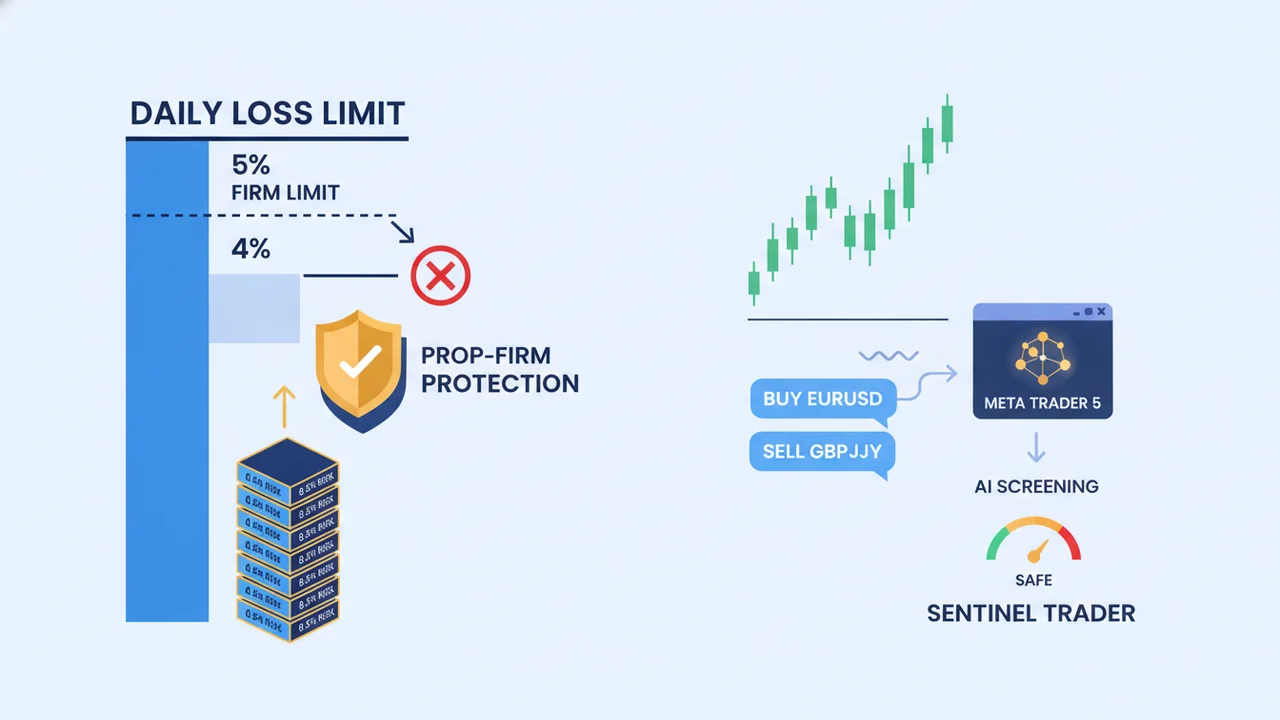
For a two-phase FTMO-style challenge, 0.25%-0.5% per trade is the range most passing traders use. It is deliberately slower than personal-account trading, because in a challenge the downside of a breach is total and the upside of speed is small. See the full risk-management framework for how to combine per-trade caps with account-level limits.
A phase-by-phase playbook
Here is a practical sequence for running copied Telegram signals through a standard two-phase evaluation.
Phase 1 - hit the target without heroics
- Cap risk at 0.5% per trade and set the daily guard buffer to ~1% under the firm's limit.
- Copy one or two vetted channels only. More channels means more correlated exposure, not more edge.
- Enforce a daily-loss pause. When the buffer is hit, the system stops for the day - no revenge trading.
- Aim for steady equity growth, roughly 1%-1.5% on good days. At 0.5% risk and a positive expectancy, the 8% target is a few good weeks, not a single lucky session.
Phase 2 - protect, don't push
The second phase usually has a lower target (around 5%). Drop risk to 0.25%-0.5% and prioritise not breaching over hitting the target fast. Most phase-two failures are traders who got greedy after clearing phase one.
Funded - the rules never relax
Once funded, the daily-loss and drawdown rules still apply, and now real payouts depend on them. Keep the same conservative settings; the account that survives drawdown is the account that pays. The difference between manual and automated execution matters most here, because emotional overrides are what end funded accounts.
Choosing signals that actually fit prop-firm rules
Not every Telegram channel is compatible with a challenge. A channel that fires 30 signals a day, runs no stop loss, or martingales after losses is structurally incompatible with a 5% daily limit, no matter how good its win rate looks. Vet for rule-compatibility, not just profit.
- Defined stop loss on every signal. No SL means no way to size the trade to your risk rule.
- Reasonable frequency. A handful of quality setups beats a firehose you cannot risk-budget.
- No grid or martingale recovery. These strategies are designed to breach drawdown rules eventually.
- A verifiable track record. Demand evidence, not screenshots.
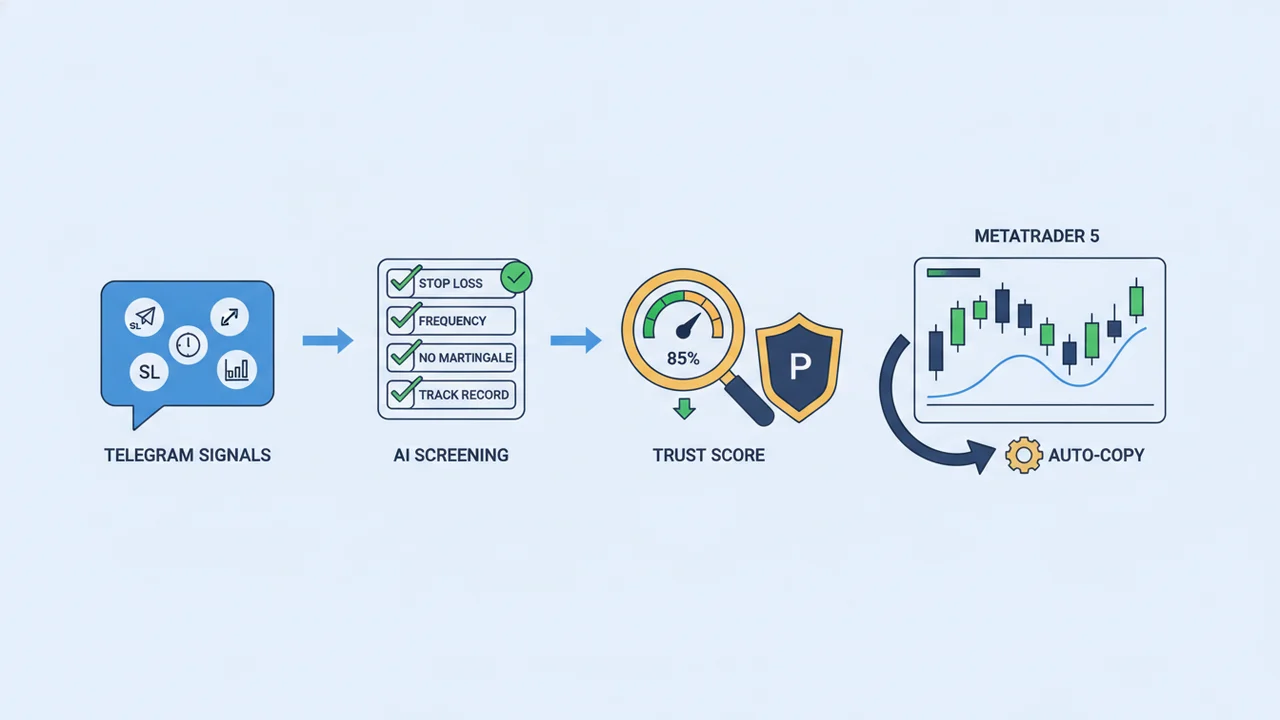
That last point is where automated verification helps. Channel forensics backtests a channel's real historical signals against 1-minute market data to produce a trust score, so you copy a track record instead of marketing. An optional AI signal-screening layer can then reject or shrink borderline signals before they ever reach your funded account. For a category overview of automated tools that do this, see our roundup of the best AI forex trading bots.
Do prop firms allow Telegram signal copying?
Most major firms allow Expert Advisors, automated execution, and copied signals on both evaluation and funded accounts - but the fine print varies, so check your firm's current terms before connecting anything. The table below summarises the common stance.
| Firm | Automated execution / EAs | Typical restriction to watch |
|---|---|---|
| FTMO | Allowed | No copying the same trades across many funded accounts; no pure latency/HFT arbitrage |
| FundedNext | Allowed | Account-level copy-trading limits; check news-trading rules |
| The5ers | Allowed | Watch high-frequency and martingale/grid restrictions |
| E8 | Allowed | Confirm copy-trading and EA terms for your specific program |
The recurring theme is that firms care less about where a signal comes from and more about how it is risk-managed and whether you are gaming their evaluation. A single account copying one or two vetted channels with strict per-trade sizing is well within normal terms; copying one signal across a dozen funded accounts is the pattern that gets flagged. When in doubt, read the firm's rule page and ask support in writing.
Common mistakes that fail challenges
- Copying the provider's lot size. Always size from your own equity, never theirs.
- Running too many channels. Correlated EURUSD and GBPUSD longs are effectively one bigger trade.
- No automated daily stop. Manual discipline fails during the exact volatility that breaches the limit.
- Trading the news. A single high-impact release can gap straight through a stop; many passing traders use a news filter to pause around red-folder events.
- Revenge trading after a loss. The fastest route from "down 2%" to "challenge over."
The bottom line
Passing a prop firm challenge with Telegram signals comes down to one discipline: never let a bad session breach a loss limit. Vet channels for rule-compatibility, size every trade from a fixed 0.25%-0.5% of your own equity, and put an automated equity guard under the account so a breach is physically blocked rather than hopefully avoided. Do that and copied signals become a legitimate, hands-off path to a funded account.
Telegram AI Trader builds these controls in by default - PropFirmGuard, per-trade sizing, AI signal screening, and channel forensics - across FTMO, FundedNext, The5ers, and E8. See pricing or start a free trial.
Frequently Asked Questions
Can you pass a prop firm challenge using Telegram signals?
Yes. Prop firms like FTMO, FundedNext, and The5ers allow copied signals and automated execution as long as you trade your own account and follow the rules. The challenge is not the signals - it is staying inside the daily-loss and maximum-drawdown limits, which is why an automated risk guard matters more than the signal source.
What fails most traders in a prop firm challenge?
Loss limits, not profit targets. Industry data on more than 300,000 challenge accounts shows roughly 70% of failures come from breaching the maximum-drawdown or daily-loss rule. Hitting the profit target is rarely the problem; surviving the variance long enough to get there is.
What risk per trade should I use to pass a challenge?
Most traders who pass risk 0.25% to 0.5% of account equity per trade during the evaluation. On a 5% daily-loss limit, 0.5% risk gives you roughly ten losing trades of headroom in a day, which is usually enough to absorb a bad session without a breach.
Will a signal copier automatically respect my prop firm's daily-loss limit?
Only if it has a prop-firm risk guard. A basic copier mirrors every signal blindly. Telegram AI Trader's PropFirmGuard tracks account equity in real time and blocks or closes trades before your daily-loss or drawdown buffer is hit, on FTMO, FundedNext, The5ers, and E8 accounts.
Is automated signal copying against prop firm rules?
Most modern firms permit Expert Advisors and copy trading on evaluation and funded accounts, but some restrict copy trading across multiple accounts or specific high-frequency strategies. Always read your firm's exact terms before connecting a copier, and avoid copying the same signal across many funded accounts simultaneously.
Ready to Automate Your Trading?
Join traders who never miss a signal. Start with a free trial and see the difference AI-powered automation makes.
Continue Reading
Manual vs Automated Trading
Pros and cons of manual vs automated signal execution.
Read moreComparisonSignal Copier vs Manual Execution
Compare automated and manual approaches to signal trading.
Read moreResearchAI Forex Trading Statistics 2026
Latest data on AI adoption and performance in forex trading.
Read more