Free vs Paid Telegram Forex Signals: Which Is Actually Worth It? (2026)
Free Telegram forex signals are not free - you pay through a broker referral. Paid ones are not automatically better. Here is how the two models differ, what each one costs you in practice, and how to test either before you commit money.
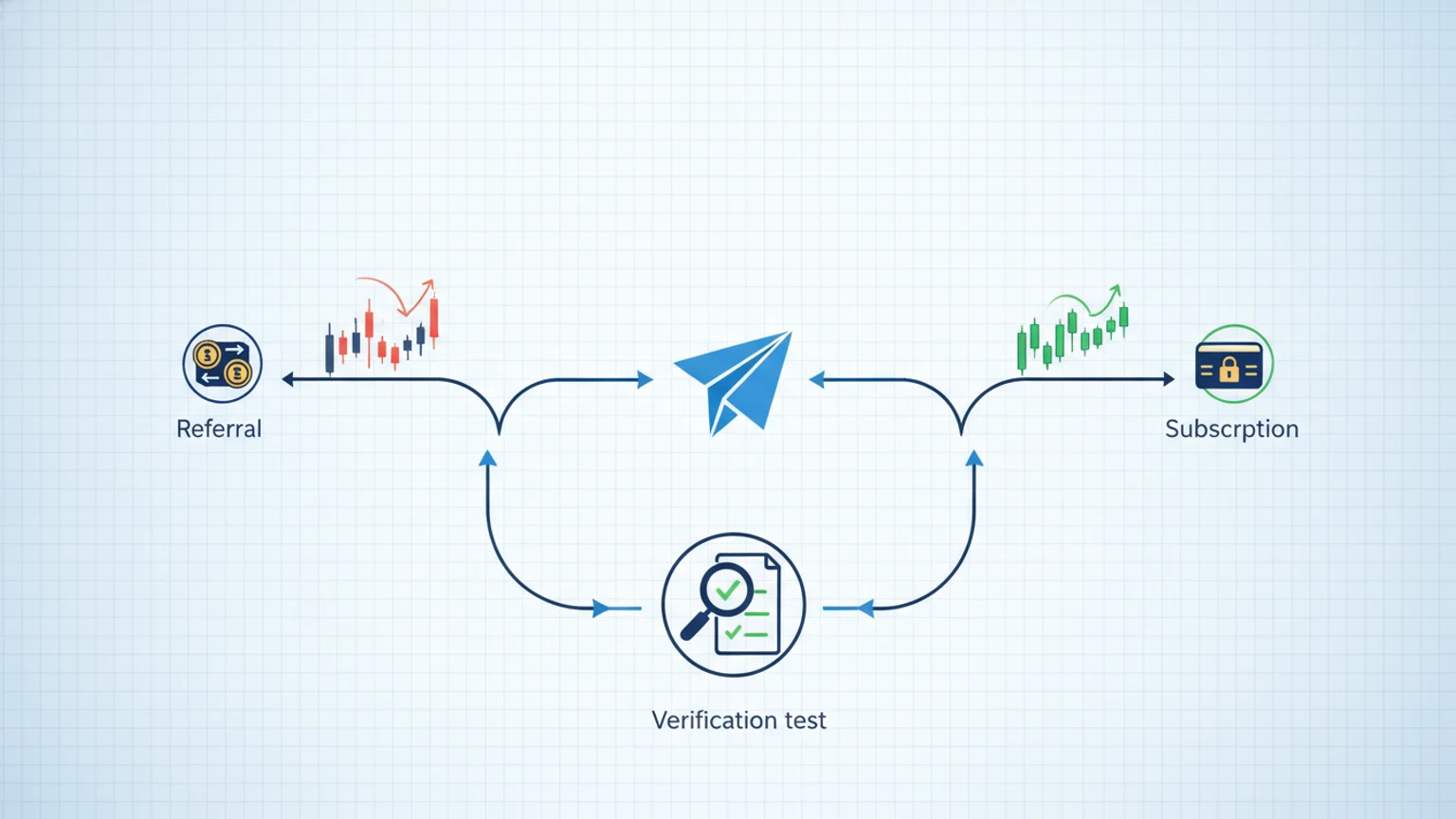
Free Telegram forex signals are rarely free and paid ones are rarely better because they are paid. The free model is usually funded by a broker referral, which pays the channel on your trading volume; the paid model is funded by your subscription, which pays the channel whether or not you make money. Both have a conflict of interest, and neither correlates with the thing you actually care about - expectancy per trade.
This guide sets out how each model works, what each really costs, and the one test that separates a channel worth following from a channel worth leaving. If you want the seven named forex channels traders ask about most, we cover those in our best forex signal Telegram channels roundup; this article is the decision underneath that list.
The number that frames the whole decision
We replay our users' Telegram channels against 1-minute price data. As of a snapshot on 15 September 2026, across 13 backtested channels and 134 completed trades:
- 4 of the 10 channels we could score had positive expectancy.
- The median scored channel lost 0.14R per trade.
- Copying every completed trade at equal risk would have returned -9.32R.
Free and paid channels are both represented in that sample, and the split does not fall neatly along the price line. The full dataset is in we backtested 13 Telegram signal channels.
Read that as neither doom nor promotion. Four channels made money. Six did not. The difference between those groups was never the subscription fee.
How each model is actually funded
| Free channels | Paid channels | |
|---|---|---|
| Revenue source | Broker referral rebates on your volume; upsells to a VIP tier; affiliate links | Monthly, annual or lifetime subscription |
| What the provider is optimising | Your trade count and your broker sign-ups | Your renewal, which means your perceived satisfaction |
| Typical failure mode | Over-posting; pushing a specific broker; the free tier is a funnel to a paid one | Cherry-picked results; a low-effort feed once you have paid; churn-and-replace marketing |
| Typical price | $0, plus a wider spread at their broker | Roughly $30-$100/month; $150-$500 lifetime |
| Can you leave cheaply? | Yes | Depends on the billing term |
| Verification available? | Rarely offered; you must do it | Sometimes offered; verify it independently |
The free model's conflict is volume. If the channel earns a rebate per lot you trade, a quiet week is a bad week for the channel and a good week for a disciplined trader. That structural pressure is why free channels post more signals than paid ones, and why their signal quality tends to be more variable rather than uniformly worse.
The paid model's conflict is retention. A subscription channel needs you to feel like it is working at the end of the month. That is the incentive behind posting "TP1 hit" the moment the first target prints and never mentioning the trade again. In our data, 29 trades reached TP1 and then stopped out, averaging -0.079R, with only 6 of the 29 ending positive. TP1 screenshots are the cheapest retention tool in the business.
Neither conflict is disqualifying. Both are things to price in.
What "free" actually costs
Run the arithmetic on a realistic case. You follow a free channel that requires its referral broker. That broker's spread on XAUUSD is 0.35 wider than the one you would otherwise use. You take 4 gold trades a week at 0.5 lots.
At $10 per 0.01 of spread per 0.5 lot, 0.35 of extra spread costs roughly $17.50 per trade in and out - call it $70 a week, or about $290 a month. That is three to nine times what a paid channel charges.
The numbers move with your broker, your size and your instrument, and plenty of free channels do not require a specific broker at all. But the general shape holds: a "free" channel tied to a referral broker is usually the most expensive option on the table for an active trader, and the cost is invisible because it arrives as spread rather than an invoice.
Which one suits you
Choose a free channel if you are learning, you trade small, you can use your own broker, and you intend to paper-trade the signals for a month before risking anything. Free channels are an excellent, zero-cost way to observe how a provider behaves over time - especially how it behaves after a losing run.
Choose a paid channel if you have already verified its history, you are trading enough size that a fixed monthly fee is small relative to your risk, and the provider gives you enough transparency to keep verifying. A $59 subscription on a $10,000 account is 0.6% a month of guaranteed drag; the edge has to clear that before it clears zero.
Choose neither if you cannot get enough history to test. This is not a soft recommendation. A provider that will not show you its full message history - including the losers - is telling you something, and a channel with a high deletion rate has already destroyed the evidence. Across 92 channels we monitor, the median channel deletes none of its messages; the outliers deleting a tenth or more are a small, identifiable group.
The one test that matters
Everything above is context. This is the method.
- Get the history. Join the channel - the free tier if there is one - and let it run for at least a month, or ask the provider for an export. You need enough signals that 30 or more will produce a completed trade.
- Replay it on real prices. For each signal, check whether price actually reached the stated entry. If it did not, the trade never existed for you, regardless of what the channel posted afterwards. In our dataset 22.6% of signals had entries price never touched - nearly a quarter of the record, gone.
- Check which came first, the stop or the target. Not the eventual outcome. The first one hit.
- Compute expectancy, not win rate.
(win rate x average win) - (loss rate x average loss). The best channel in our sample won 58.3% of its trades; another won 92.9% and made less per trade. Our free expectancy calculator does this in a browser. - Count the edits and deletions. Edits are normal - the median channel edits 58.2% of its messages, usually to record outcomes. Deletions are not.
If doing that by hand sounds like a weekend, that is roughly right, and it is why almost nobody does it. Of 120 channels our users actively monitor, 107 have never been backtested by the person copying them.
Real-Time Signal Analysis
Watch how we verify every signal against actual market data
Free, paid, and the part neither one gives you
Whichever you pick, the provider supplies one thing - an opinion about direction - and you supply everything that decides the outcome: position size, the broker, the execution, whether the stop moves to breakeven at TP1, and whether you are still following the channel after a six-trade losing run.
Telegram AI Trader is the automation layer for that second half. It copies signals from channels you are already in onto your MT5 account in the cloud, sizes every trade from a percentage of your equity rather than the provider's lot, attaches the stop and target from the signal, and manages the exit - trailing stop, breakeven, partial closes. On Pro and Advanced it also runs the backtest described above on your channels for you, and a 5-agent AI evaluation on each signal before it executes.
| Plan | Price | Channels | Trades/day | AI evaluations/day | Channel backtests |
|---|---|---|---|---|---|
| Starter | $29/mo | 3 | 20 | 0 | 0 |
| Pro | $59/mo | 10 | 50 | 30 | 5/week |
| Advanced | $99/mo | 25 | 80 | 80 | 20/week |
Being clear about the gate, because the $29 headline is what gets quoted: the verification tools start on Pro. Starter is copying and risk control only. Every plan has a 3-day trial for a $1 activation fee.
The bottom line
The free-versus-paid question is the wrong frame. A free channel charges you in spread and posts more than it should; a paid channel charges you in subscription and shows you its wins. Both are answering a question - "is this provider worth following?" - that only a backtest can answer.
Do the test on one channel before you pay for a second. If the expectancy is positive after costs and the provider does not delete its history, the price is a detail. If it is not, the price was never the problem.
Next: the seven named forex channels traders ask about most, how to spot a fake channel, and the best Telegram signal copiers for automating whichever you choose.
See pricing or start a free trial.
Frequently Asked Questions
Are free Telegram forex signals worth following?
Some are, but you should understand how they are funded before you decide. The common model is a broker referral: the channel earns a rebate on the spread or commission you generate, so its incentive is your trading volume rather than your profit. That does not make the signals bad, but it does mean a free channel has a structural reason to post more often than it should.
What is a realistic price for paid Telegram forex signals?
Most established providers sit between roughly $30 and $100 a month, with lifetime or annual options in the low hundreds. Anything advertised in the thousands is selling access, not edge. Price tells you almost nothing about quality - we have measured channels at both ends of that range with negative expectancy.
How do I test a signal channel before paying?
Ask for enough history to replay, then replay it. Take the channel's own posted entries, stops and targets and check them against 1-minute price data for the period: did price reach the entry, and did the stop or the target come first? If the provider will not show you enough history to do that, or the history is full of deleted messages, you have your answer without paying anything.
Should I copy a free and a paid channel at the same time?
Only if you count the combined risk. Most Telegram forex channels trade gold - in our own dataset, three quarters of all signals were XAUUSD - so two channels frequently produce the same directional bet at the same time. Two positions at 1% each in the same instrument is a 2% trade, not diversification.
Ready to Automate Your Trading?
Join traders who never miss a signal. Start with a free trial and see the difference AI-powered automation makes.
Continue Reading
Best Telegram Signal Copier for Prop Firm Accounts (2026)
The best Telegram signal copiers for prop-firm and funded accounts in 2026, ranked on prop-firm risk controls, platform support, and price.
Read moreComparisonBest AI Forex Trading Bots (2026)
An honest 2026 ranking of the best AI forex trading bots, compared on AI features, prop-firm safety, and price.
Read moreProp Firm TradingHow to Pass a Prop Firm Challenge Using Telegram Signals (2026)
Use Telegram signals to pass a prop firm challenge without breaking the daily-loss or drawdown rule that fails 7 in 10 traders.
Read more